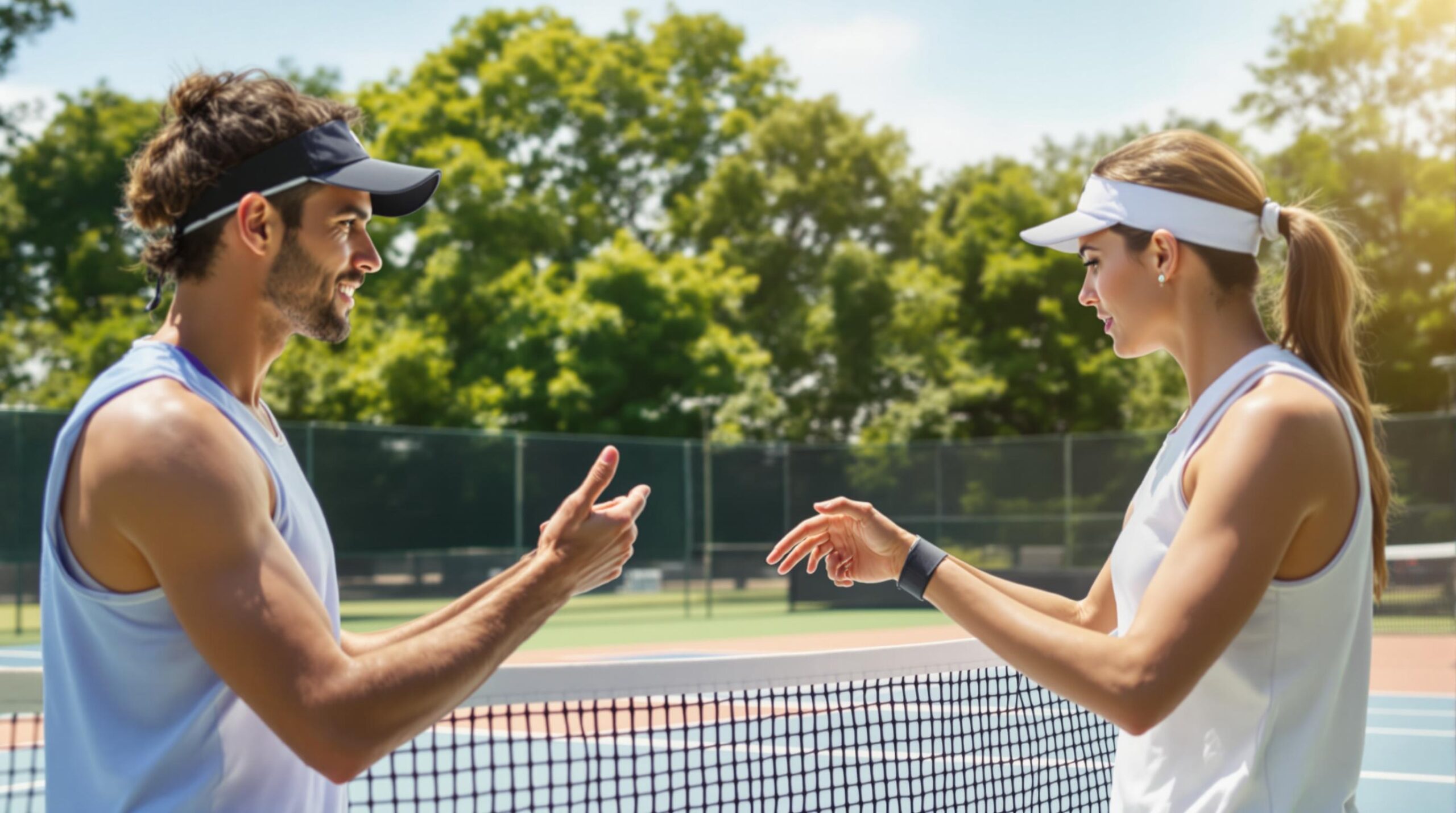
Want to win more doubles games? Start with clear communication! Strong communication helps you and your partner stay in sync, avoid mistakes, and play smarter. Here’s a quick breakdown of how to improve it:
Want to get better fast? Regular practice and match play, like in Paddle Party leagues, can help you master these skills and build stronger partnerships.
Verbal commands help teammates stay coordinated and avoid mix-ups during fast-paced games. Here’s a quick guide:
| Command | Meaning | When to Use |
|---|---|---|
| "Mine!" | You’re taking the shot | When you’re hitting the ball |
| "Yours!" | Partner should take it | When letting your partner hit |
| "Switch!" | Change positions | During position changes |
| "No!" | Let the ball go out | When spotting an out ball |
| "Middle!" | Ball heading between players | For middle court shots |
| "Back!" | Move to the baseline | When retreating |
Keep these commands short and clear to ensure they cut through the noise on the court. Practicing them during warm-ups can make them second nature.
When verbal cues aren’t enough, non-verbal communication becomes crucial.
Courts can get noisy, making non-verbal signals a must. Doubles teams often rely on these visual cues to stay in sync:
Make it a habit to face your partner during breaks. This allows you to quickly read their signals and adjust your play accordingly.
Taking a few minutes before the match to plan your communication strategy can make a big difference. Use this time to agree on:
Discussing personal preferences also helps the team gel better. Talk about:
A well-thought-out pre-game plan builds trust and ensures smoother teamwork during the match.
Trust goes beyond just communication – it’s about having complete confidence in your partner’s choices on the court. Each player brings their own strengths, and trust allows those strengths to shine.
Here’s how to build trust during play:
When trust is in place, you can focus fully on your role without distractions. Support each other in every play, and carry that teamwork into consistent practice sessions.
Regular practice is key to developing chemistry and understanding between partners. A well-structured practice helps you build trust and improve coordination.
| Practice Focus | Purpose | Key Activities |
|---|---|---|
| Shot Patterns | Learn partner tendencies | Drive and volley drills |
| Position Switching | Improve court coverage | Stacking practice |
| Game Scenarios | Strengthen decision-making | Point-play situations |
| Communication Drills | Boost verbal/non-verbal cues | Call-out exercises |
To get the most out of your practice:
Practice until your movements and decisions become second nature. This automatic response is crucial during high-pressure matches, where every second counts. When trust is solid, your team will move as one, covering the court effectively and making quick, confident decisions – essential for success in competitive play.
Solid court coverage builds on pre-game planning and trust between partners, keeping your team in sync during play.
Good court coverage starts with assigning roles that match each player’s strengths. For instance, a player skilled at volleying might take the net, while a partner with strong groundstrokes handles the baseline. Factor in dominant sides, reaction times, and physical abilities when deciding roles. This setup ensures smoother coordination, especially during fast rallies, and helps manage shared zones effectively.
Clear communication is critical for handling balls in shared areas. Teams should use simple, agreed-upon verbal cues to avoid confusion over who will take control. Quick, decisive calls help prevent coverage gaps and maintain balanced defense.
Stacking keeps doubles teams in their preferred positions throughout a match. This strategy works best with precise signals and timing. For example, partners might use hand signals or code words to coordinate movements during serves, returns, or mid-rally adjustments. Regular practice sharpens these skills, improving coordination and communication.
Every game offers a chance to sharpen team communication. By spotting recurring challenges and focusing on specific areas to improve, partners can boost their overall gameplay.
Post-match analysis is key to building stronger team dynamics. After each game, take time to review critical communication moments with your partner. Talk about situations where communication worked well – or fell short. For example, was there confusion about court positioning? Were signals unclear? Keep a record of these observations, like noting a missed signal on a short lob, to identify patterns that need attention.
Set measurable goals to track your improvement. For instance, Paddle Party league players can assess their progress by how smoothly they schedule matches. If scheduling becomes more organized and confusion-free, it’s a sign of better off-court coordination – something that often translates to stronger in-game performance. Compare results from match to match to spot trends, celebrate wins, and adjust strategies for future games.
Paddle Party leagues are designed to help players improve their doubles communication skills. By offering consistent match opportunities, the league creates a perfect setting for teams to build stronger on-court connections.
Paddle Party’s league format provides teams with regular chances to work on their communication techniques, with over 20,000 matches played on the platform. Its scheduling flexibility allows partners to choose match times that suit them, encouraging pre-game strategy discussions and planning.
The league features multiple divisions, ranging from Novice Beginner to Advanced, ensuring fair competition. This balanced setup allows players to focus on teamwork and communication without unnecessary pressure.
"Thank you so much! I had a great time and met some wonderful people." – Nina Wojtalewicz, Raleigh, NC
Paddle Party’s community of over 2,500 players across the U.S. provides a welcoming environment where teams can try out and refine their communication techniques. The relaxed atmosphere encourages players to experiment with signals and strategies without feeling overwhelmed.
For those joining without a partner, the league’s partner-pairing system is a great way to practice communication with different playing styles, helping players adapt and improve their teamwork.
"Appreciate all the behind the scenes efforts in managing the league!" – Dana Garnett, Dallas, TX
The league also fosters interaction between teams before, during, and after matches. These interactions allow players to:
Together, these elements help players enhance their on-court communication, setting the stage for better teamwork and future success.
In doubles play, clear communication – both verbal and non-verbal – is the key to functioning as a unified team. Paddle Party’s league format offers a great opportunity to practice and improve these skills during regular matches.
Here are some essentials successful doubles teams focus on:
Ready to take your team’s communication to the next level? Here’s how to get started: