Author: Abhimanyu

  • How Doubles Teams Improve Court Communication

    How Doubles Teams Improve Court Communication

    Want to win more doubles games? Start with clear communication! Strong communication helps you and your partner stay in sync, avoid mistakes, and play smarter. Here’s a quick breakdown of how to improve it:

    • Use Verbal Commands: Simple calls like "Mine!" or "Switch!" ensure clarity during fast-paced rallies.
    • Practice Non-Verbal Signals: Hand gestures and body language help when the court gets noisy.
    • Plan Before Matches: Discuss strategies, signals, and roles to avoid confusion.
    • Avoid Common Mistakes: Prevent delayed calls, conflicting actions, and vague signals by practicing clear routines.
    • Build Trust: Respect your partner’s decisions and encourage each other during play.

    Want to get better fast? Regular practice and match play, like in Paddle Party leagues, can help you master these skills and build stronger partnerships.

    Clear Communication Methods

    Basic Verbal Commands

    Verbal commands help teammates stay coordinated and avoid mix-ups during fast-paced games. Here’s a quick guide:

    Command Meaning When to Use
    "Mine!" You’re taking the shot When you’re hitting the ball
    "Yours!" Partner should take it When letting your partner hit
    "Switch!" Change positions During position changes
    "No!" Let the ball go out When spotting an out ball
    "Middle!" Ball heading between players For middle court shots
    "Back!" Move to the baseline When retreating

    Keep these commands short and clear to ensure they cut through the noise on the court. Practicing them during warm-ups can make them second nature.

    When verbal cues aren’t enough, non-verbal communication becomes crucial.

    Hand Signals and Body Language

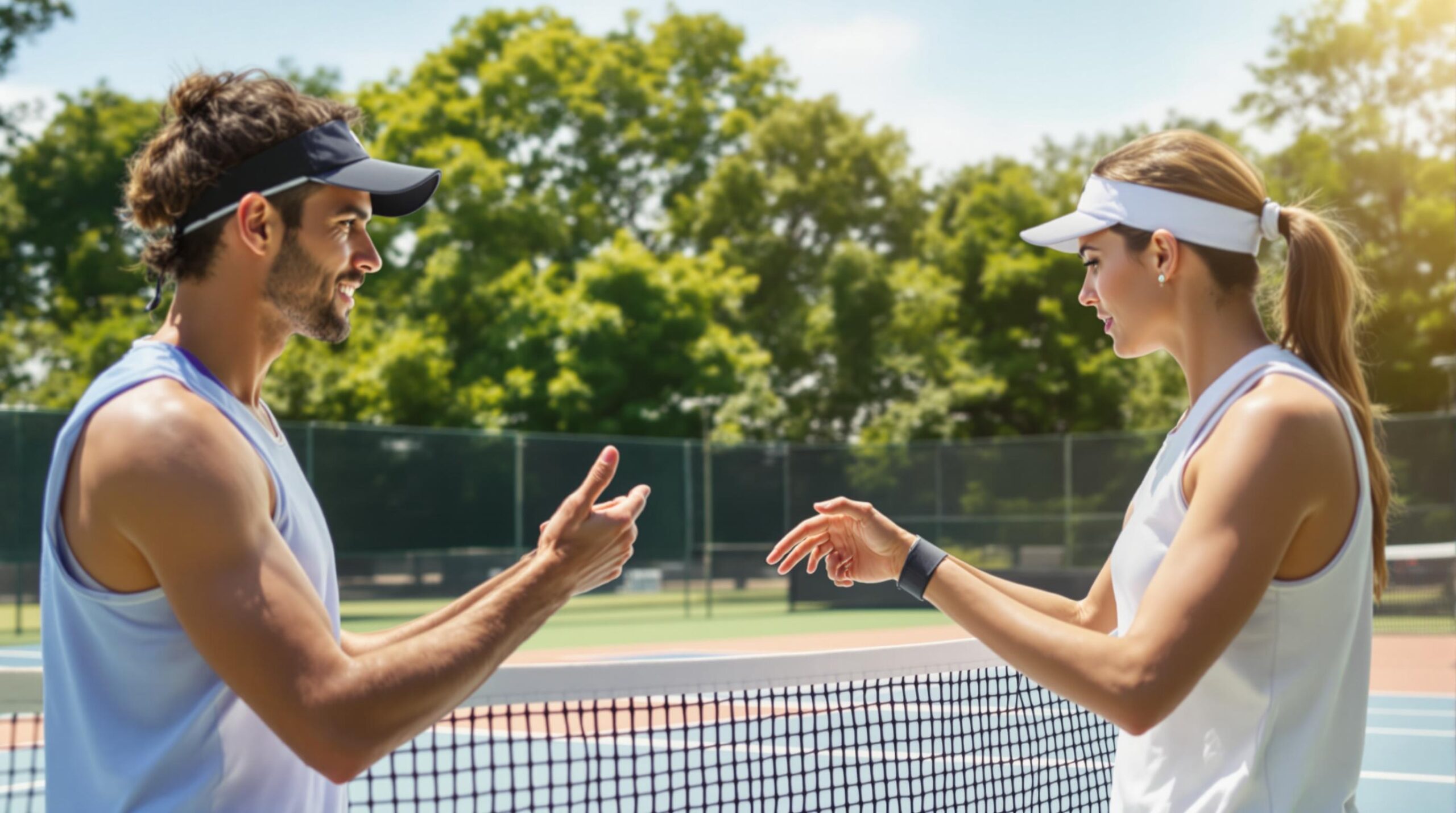
    Courts can get noisy, making non-verbal signals a must. Doubles teams often rely on these visual cues to stay in sync:

    • Point to target – Shows where you plan to serve or return.
    • Raised fist – Signals readiness for aggressive net play.
    • Open palm down – Indicates staying back for a defensive position.
    • Tapping paddle on court – Acknowledges your partner’s signal.
    • Side-to-side head shake – Disagrees with a planned shot or strategy.

    Make it a habit to face your partner during breaks. This allows you to quickly read their signals and adjust your play accordingly.

    Pre-Game Planning

    Taking a few minutes before the match to plan your communication strategy can make a big difference. Use this time to agree on:

    • Verbal commands and hand signals
    • Court positioning and formations
    • Service and return strategies
    • Net play and defensive coverage

    Discussing personal preferences also helps the team gel better. Talk about:

    • Your preferred side of the court
    • Comfort with specific shots
    • Any physical limitations
    • Strategies for managing energy levels

    A well-thought-out pre-game plan builds trust and ensures smoother teamwork during the match.

    Building Partner Trust

    Trusting Your Partner’s Decisions

    Trust goes beyond just communication – it’s about having complete confidence in your partner’s choices on the court. Each player brings their own strengths, and trust allows those strengths to shine.

    Here’s how to build trust during play:

    • Respect your partner’s shot choices without second-guessing them.
    • Follow court coverage calls immediately to avoid hesitation.
    • Encourage with positive reinforcement, praising good plays and moving past mistakes quickly.

    When trust is in place, you can focus fully on your role without distractions. Support each other in every play, and carry that teamwork into consistent practice sessions.

    Regular Practice Sessions

    Regular practice is key to developing chemistry and understanding between partners. A well-structured practice helps you build trust and improve coordination.

    Practice Focus Purpose Key Activities
    Shot Patterns Learn partner tendencies Drive and volley drills
    Position Switching Improve court coverage Stacking practice
    Game Scenarios Strengthen decision-making Point-play situations
    Communication Drills Boost verbal/non-verbal cues Call-out exercises

    To get the most out of your practice:

    • Schedule 1-2 sessions per week.
    • Set specific goals for each session.
    • Include pressure drills to simulate match intensity.
    • Evaluate your performance and adjust as needed.

    Practice until your movements and decisions become second nature. This automatic response is crucial during high-pressure matches, where every second counts. When trust is solid, your team will move as one, covering the court effectively and making quick, confident decisions – essential for success in competitive play.

    Pickleball COMMUNICATION: The Most Important Skill in …

    sbb-itb-b64fdb6

    Court Coverage Basics

    Solid court coverage builds on pre-game planning and trust between partners, keeping your team in sync during play.

    Player Position Assignments

    Good court coverage starts with assigning roles that match each player’s strengths. For instance, a player skilled at volleying might take the net, while a partner with strong groundstrokes handles the baseline. Factor in dominant sides, reaction times, and physical abilities when deciding roles. This setup ensures smoother coordination, especially during fast rallies, and helps manage shared zones effectively.

    Middle Court Defense

    Clear communication is critical for handling balls in shared areas. Teams should use simple, agreed-upon verbal cues to avoid confusion over who will take control. Quick, decisive calls help prevent coverage gaps and maintain balanced defense.

    Stacking and Position Switching

    Stacking keeps doubles teams in their preferred positions throughout a match. This strategy works best with precise signals and timing. For example, partners might use hand signals or code words to coordinate movements during serves, returns, or mid-rally adjustments. Regular practice sharpens these skills, improving coordination and communication.

    Learning From Each Match

    Every game offers a chance to sharpen team communication. By spotting recurring challenges and focusing on specific areas to improve, partners can boost their overall gameplay.

    Match Analysis Tips

    Post-match analysis is key to building stronger team dynamics. After each game, take time to review critical communication moments with your partner. Talk about situations where communication worked well – or fell short. For example, was there confusion about court positioning? Were signals unclear? Keep a record of these observations, like noting a missed signal on a short lob, to identify patterns that need attention.

    Tracking Progress

    Set measurable goals to track your improvement. For instance, Paddle Party league players can assess their progress by how smoothly they schedule matches. If scheduling becomes more organized and confusion-free, it’s a sign of better off-court coordination – something that often translates to stronger in-game performance. Compare results from match to match to spot trends, celebrate wins, and adjust strategies for future games.

    League Play Benefits with Paddle Party
    Paddle Party

    Paddle Party leagues are designed to help players improve their doubles communication skills. By offering consistent match opportunities, the league creates a perfect setting for teams to build stronger on-court connections.

    Regular Match Experience

    Paddle Party’s league format provides teams with regular chances to work on their communication techniques, with over 20,000 matches played on the platform. Its scheduling flexibility allows partners to choose match times that suit them, encouraging pre-game strategy discussions and planning.

    The league features multiple divisions, ranging from Novice Beginner to Advanced, ensuring fair competition. This balanced setup allows players to focus on teamwork and communication without unnecessary pressure.

    "Thank you so much! I had a great time and met some wonderful people." – Nina Wojtalewicz, Raleigh, NC

    Community Support

    Paddle Party’s community of over 2,500 players across the U.S. provides a welcoming environment where teams can try out and refine their communication techniques. The relaxed atmosphere encourages players to experiment with signals and strategies without feeling overwhelmed.

    For those joining without a partner, the league’s partner-pairing system is a great way to practice communication with different playing styles, helping players adapt and improve their teamwork.

    "Appreciate all the behind the scenes efforts in managing the league!" – Dana Garnett, Dallas, TX

    The league also fosters interaction between teams before, during, and after matches. These interactions allow players to:

    • Learn effective communication techniques by observing others
    • Test new signals and verbal cues in a relaxed setting
    • Fine-tune their existing strategies through regular play
    • Build stronger partnerships through consistent engagement

    Together, these elements help players enhance their on-court communication, setting the stage for better teamwork and future success.

    Conclusion: Steps to Better Team Communication

    Main Communication Tips

    In doubles play, clear communication – both verbal and non-verbal – is the key to functioning as a unified team. Paddle Party’s league format offers a great opportunity to practice and improve these skills during regular matches.

    Here are some essentials successful doubles teams focus on:

    • Pre-match planning: Discuss tactics and signals before the game begins.
    • Clear verbal commands: Use short, sharp calls that can be easily heard over the noise.
    • Consistent hand signals: Stick to the same gestures to avoid confusion.
    • Defined court roles: Make sure each player knows their responsibilities for every point.

    Next Steps

    Ready to take your team’s communication to the next level? Here’s how to get started:

    1. Join league play: Sign up with Paddle Party to participate in regular matches that sharpen communication and teamwork.
    2. Find the right partner: Use Paddle Party’s partner-matching system to connect with players who complement your style.
    3. Practice intentional communication: Focus on using clear signals and calls in every match to build stronger habits.

    Related Blog Posts

  • How to Regain Momentum in Pickleball Matches

    How to Regain Momentum in Pickleball Matches

    Momentum can make or break your pickleball game. Losing it? Here’s how to get it back:

    • Spot Momentum Shifts Early: Watch for signs like unforced errors, poor positioning, risky shots, or hesitation.
    • Reset Quickly: Use time-outs, adjust your shot choices, or slow the pace to disrupt your opponent’s rhythm.
    • Sharpen Focus: Practice breathing techniques like "4-4-4" (inhale, hold, exhale for 4 seconds each) and use pre-point routines to stay calm and prepared.
    • Communicate: Stay positive with your partner through simple, encouraging cues.

    In Paddle Party leagues or casual play, these strategies help you stay in control and recover from setbacks. Practice drills like cross-court dinking or reset drop shots to improve consistency and regain momentum when it matters most.

    Struggling with Your Pickleball Mental Game & Confidence …

    Spotting Momentum Changes

    Catching momentum shifts early can help you regain control before it’s too late. Pay attention to both physical and mental signs so you can respond effectively.

    Signs You’re Losing Control

    Physical changes often show up before the score reflects a shift in momentum. Here are some key signs to watch for:

    • Unforced Errors: Repeated mistakes on shots you typically execute well.
    • Court Positioning: Frequently out of position or being pushed wide.
    • Shot Selection: Opting for risky shots instead of safer plays.
    • Playing Speed: Either rushing your shots or slowing down excessively.
    • Partner Communication: Less verbal interaction and weaker coordination with your partner.

    For example, if your opponents start controlling areas like the kitchen while you’re stuck defending, it’s a clear sign of a momentum shift. These physical cues often tie into mental patterns that also need attention.

    Reading Your Mental State

    Physical cues give you immediate feedback, but your mental state offers a deeper understanding of your performance. Be mindful of these emotional signals:

    • Decision Hesitation: Overthinking your choices or delaying between points.
    • Body Language: Slouched shoulders, dropped head, or avoiding eye contact.
    • Internal Dialogue: Negative self-talk or replaying past mistakes in your head.
    • Energy Level: Feeling unusually drained without being physically tired.
    • Focus Shifts: Getting distracted by the crowd, the score, or other external factors.

    In Paddle Party leagues, where matches span multiple games, these mental cues are especially important. The relaxed structure allows you to adjust your mindset without the high stakes of traditional tournaments.

    Here’s a quick guide to monitor your mental state and respond effectively:

    Mental State Indicator Early Warning Sign Action Required
    Focus Level Missing obvious shot opportunities Take a deep breath between points
    Emotional Control Visible frustration after errors Reset your routine before serving
    Partner Dynamic Decreased communication Make eye contact and share cues
    Game Awareness Failing to track opponent patterns Call a timeout to discuss strategy

    Game Adjustments to Reset Momentum

    When the game starts slipping away, it’s time to tweak your approach. Simple moves like calling a time-out or changing your play style can help turn things around.

    Calling Time-Outs Wisely

    A well-timed time-out can stop your opponents’ momentum. Use this pause to catch your breath, rehydrate, and discuss your next moves with your partner. It’s also a chance to clear your head and get back on track.

    Changing Shots and Positions

    Switching up your play style can throw your opponents off balance. Slow things down between points to regain focus or mix up your shots with a blend of fast and slower plays. This unpredictability can break their rhythm.

    The key is teamwork. When both players adjust and stay in sync, it’s easier to regain control, especially in Paddle Party matches where strategy can make all the difference.

    sbb-itb-b64fdb6

    Mental Focus Techniques

    Once you’ve refined your game strategy, sharpening your mental focus can give you an extra edge.

    Your mindset has a direct impact on your performance. Staying mentally sharp helps you remain calm and collected, even when the momentum shifts.

    Self and Partner Support

    A solid mental approach starts with positive communication. During tough moments, short, encouraging signals can make a big difference.

    Here are a few examples:

    • "Nice effort on that shot."
    • "Let’s keep it deep."
    • "One point at a time."

    These small affirmations keep the energy positive and the focus forward.

    Breathing and Focus Methods

    The "4-4-4" breathing technique is a simple way to stay calm and focused:

    • Inhale for 4 seconds.
    • Hold your breath for 4 seconds.
    • Exhale for 4 seconds.

    This method helps steady your heart rate and clears your mind. Use it during breaks to regain emotional balance and stay in the moment.

    Point Start Routines

    Having a consistent routine before each point helps reset your focus and prepare for the next play. Here’s a framework to follow:

    1. Physical Reset: In about three seconds, adjust your grip, set your feet shoulder-width apart, and bounce lightly to stay loose.
    2. Mental Reset: Focus on your immediate goal by:

      • Visualizing your target.
      • Taking a deep breath.
      • Saying a cue word like "focus" or "ready."
    3. Action Ready: Get into your ready position, keeping your eyes on the ball or the server. Aim to complete this routine in 8–10 seconds.

    The key is consistency. Whatever steps you choose, practice them during training so they become second nature during matches. These routines act as mental anchors, helping you recover quickly from setbacks.

    In high-pressure situations, these techniques are especially helpful. They allow you to stay composed, focus on executing your strategy, and avoid getting distracted by the score or past mistakes. Combine these mental routines with tactical adjustments to keep the momentum in your favor.

    Practice Drills for Better Control

    Focused practice helps you master momentum control. Try these simple kitchen drills to sharpen your consistency and take back control during a match. These exercises are designed to turn tactical tweaks into real, on-court skills.

    Kitchen Control Practice

    Here are a few drills to work on:

    • Cross-Court Dinking Drill
      Work on diagonal dinks with a partner from the kitchen line. Keep your shots low and controlled to maintain steady, reliable rallies.
    • Reset Drop Shot Practice
      Stand at the baseline and aim for soft drop shots that land in the kitchen. This forces your opponent to lift the ball, slowing the pace of the game.
    • Volley Response Training
      Practice volleying at the kitchen line with balls fed at different heights and speeds. Focus on placing your shots accurately rather than hitting with power.

    Consistently working on these drills will help you strengthen the momentum recovery techniques we’ve touched on earlier.

    Conclusion: Building Momentum Skills

    Main Points Review

    Let’s quickly revisit the momentum skills we’ve covered. Success in momentum control comes down to tactical awareness and mental strength. Spot momentum shifts early and adjust your approach to stay confident, even in tough matches.

    Momentum changes happen in every game – it’s part of the process. Use these moments to put your mental techniques into action. Simple strategies like controlled breathing and purposeful shot choices during high-pressure points can make a noticeable difference. Take these lessons into your Paddle Party matches to sharpen your momentum management.

    Applying These Skills in Paddle Party Games

    Paddle Party

    Paddle Party leagues are the perfect place to practice these techniques. With divisions based on skill level, you’ll face opponents who challenge you just enough, making it easier to test and refine your strategies.

    Here are a few tips for league play:

    • Take time to recover between matches.
    • Learn from other players in your community.
    • Track your improvement throughout the 6-week season.

    The structured format of Paddle Party’s 6-week season gives you plenty of chances to work on momentum control. Use these insights alongside your regular drills to keep improving and build steady confidence in your game.

    Related posts

  • 6 Solutions for Common Pickleball League Challenges

    6 Solutions for Common Pickleball League Challenges

    Running a pickleball league can be tricky, but solving common challenges like scheduling conflicts or mismatched skill levels makes it much easier. Here’s a quick summary of solutions:

    • Fix Schedule Conflicts: Use digital tools like Paddle Party to automate scheduling, reduce cancellations, and set consistent play times.
    • Balance Skill Levels: Group players by ratings (e.g., DUPR) and adjust divisions as needed for fair competition.
    • Keep Matches Friendly: Set clear behavior rules, follow official guidelines, and resolve disputes quickly.
    • Reduce Court Wait Times: Organize efficient player rotations, use off-peak hours, and manage match flow effectively.
    • Keep Players Active: Track stats, reward achievements, and highlight progress to boost engagement.
    • Plan for Bad Weather: Secure indoor courts, communicate updates promptly, and encourage indoor practice.

    These strategies ensure smoother operations, fair play, and happier players. Whether addressing scheduling, skill levels, or weather disruptions, small changes can make a big difference.

    Mastering the Game: Successful Strategies for Operating an …

    1. Fix Schedule Conflicts

    Scheduling conflicts can disrupt leagues, but digital tools make match planning and regular play much easier.

    Set Up Online Scheduling

    Digital platforms simplify managing player availability and court assignments. With the right system, you can minimize scheduling issues and avoid last-minute cancellations.

    "Our members love the CourtReserve App ease of use to book their events and court time which leads to fuller events and more reservations and fewer calls and emails to staff. We appreciate how much CourtReserve is always innovating and improving the software to make it work better for the club, staff, and players!" – Christy H, Co-Founder

    Platforms like Paddle Party are great for addressing scheduling problems. They can:

    • Automate match schedules and court assignments
    • Let players mark their availability ahead of time
    • Manage waitlists for quick replacements
    • Send automated reminders to reduce no-shows

    Choose the Right Match Format

    The number of courts available should influence the match format you select. Here’s a quick guide:

    Courts Available Recommended Format Best For
    1–2 Round Robin Small groups (8–16 players)
    3–4 Pool Play + Single Elimination Medium groups (16–32 players)
    5+ Pool Play + Double Elimination Large groups (32+ players)

    For ongoing leagues, ladder tournaments work well. They allow players to schedule matches at their convenience within a set timeframe, keeping competition balanced.

    Pick Regular Weekly Times

    Consistent scheduling helps players plan better and reduces conflicts. For example, Stone Creek Pickleball Club successfully managed over 100 members during a 3-week period using a structured schedule.

    To establish regular times:

    • Schedule matches during peak times, like weekday evenings or weekend mornings
    • Use 90-minute blocks for competitive matches
    • Add buffer time between matches
    • Offer both weekday and weekend options for flexibility

    2. Balance Skill Levels

    Uneven skill levels can ruin the fun in any league. A solid rating system and clear rules for dividing players can help keep matches competitive and enjoyable.

    Group Players by Rating

    DUPR (Dynamic Universal Pickleball Rating) is a reliable way to sort players into the right divisions. This free system, used by professional pickleball tours, assigns ratings from 2.000 to 8.000 based on actual match results.

    Here’s a simple way to organize divisions using DUPR:

    Skill Level DUPR Rating Range Recommended Division
    Beginner 2.000 – 2.999 Recreational
    Intermediate 3.000 – 3.999 Competitive B
    Advanced 4.000 – 4.999 Competitive A
    Elite 5.000+ Premier

    "As an active pickleball player, I know the importance of competing against players at your level for maximum enjoyment… DUPR is the most accurate system out there that gives all players a simple and easy way to know their skill level."
    – Andre Agassi, Former World #1 Tennis Player

    These ratings can also guide adjustments to divisions throughout the season.

    Set Up Division Movement

    • Players who consistently win should move up.
    • Players who struggle repeatedly may need to move down.
    • Make changes gradually and only between adjacent divisions.
    • Adjust placements during natural breaks, like between seasons or round-robin cycles.

    Test Skills Before Season

    Once you’ve outlined movement rules, confirm player placements with a pre-season evaluation. Paddle Party’s skill-based divisions help organize players from beginner to advanced levels.

    "I enjoy teaching immensely, but it’s always difficult when people sign up for the wrong skill level clinic. They simply don’t know any better. I’m excited to have a way for your everyday player to know where they stand so that they can learn and compete with people of their own skill level."
    – Zane Navratil

    • Start with USA Pickleball’s self-rating system as a baseline.
    • Have new players attend an evaluation session.
    • Monitor early performance and adjust placements after a few matches.

    Matching players with similar skills makes games more fun and keeps everyone engaged, boosting player retention over time.

    3. Keep Matches Friendly

    Good sportsmanship plays a big role in making league games enjoyable for everyone. Clear rules and fair enforcement create a positive atmosphere during matches. Below are some steps and guidelines to encourage fair play and ensure everyone feels welcome.

    Set Behavior Standards

    Establish clear behavior rules to avoid conflicts. Using USA Pickleball’s sportsmanship guidelines as a foundation, consider these key points:

    Behavior Category Expected Actions
    Court Etiquette • Introduce yourself
    • Acknowledge good plays
    Line Calls • Make honest calls on your side
    • Respect opponent’s calls
    • Resolve uncertain calls in favor of your opponent
    Partner Relations • Support your partner
    • Correct any incorrect calls your partner makes
    • Avoid negative comments

    "Pickleball was created to be a fun, competitive, and highly social sport. Since its inception, it has embodied an ethic of good sportsmanship that includes respect, fair play, and graciousness in winning and losing." – USA Pickleball Sportsmanship Guide

    Stick to Official Rules

    On top of behavior guidelines, follow these essential principles:

    • Only make line calls for balls landing on your side of the court.
    • Call faults on yourself or your partner when they happen.
    • Request replays only for valid reasons, like unexpected distractions.
    • Avoid coaching unless someone specifically asks for advice.

    During casual games, stronger players should avoid aggressively targeting weaker ones. This keeps the game fun and welcoming for players of all skill levels.

    Resolve Disputes Quickly

    Addressing disputes promptly keeps matches running smoothly. Here’s how disputes can be handled:

    1. First Step: Let players try to resolve disagreements on their own.
    2. Second Step: If players can’t agree, involve a league coordinator to mediate.
    3. Final Step: Use official rules to make a clear and final decision.

    League administrators should keep records of disputes and their resolutions. This helps identify recurring issues and refine policies to prevent future problems. Regular monitoring ensures the league remains a positive and enjoyable space for all players.

    sbb-itb-b64fdb6

    4. Reduce Court Wait Times

    Keeping games moving smoothly is essential for maintaining an enjoyable experience on the court. Efficient scheduling and rotation systems can help minimize wait times.

    Set Up Player Rotations

    Organizing player rotations is a simple way to keep everyone involved. Here are a few rotation methods:

    Rotation Type How It Works Best Used When
    Four on, Four off The next 4 players in line take the court when it’s free Large groups with mixed skill levels
    Challenge Court Winners stay on the court, and losers move to the back of the line Multiple courts are available
    Skill-Based Groups Players rotate within their skill level groups Clear skill divisions are present

    "One of the unique parts of pickleball is the amount of participation that happens at open play (some call it paddle stack)." – Jason Flamm

    Accelerate Match Flow

    • Rotate players after three games to maintain momentum.
    • Use color-coded signals or markers to clearly show which courts are available.

    Schedule Off-Hours Play

    Encourage players to book early-morning slots (before 9:00 AM) or use attendance data to make better use of off-peak hours.

    These strategies make it easier to keep players engaged and ensure everyone gets ample time on the court.

    5. Keep Players Active

    Keeping players engaged is key to running a successful pickleball league. Tracking progress and recognizing achievements can help maintain enthusiasm and participation. Just like efficient scheduling keeps things moving smoothly, tracking stats and offering rewards keeps the league buzzing.

    Highlight Player Stats

    Sharing player stats helps build accountability and keeps everyone motivated. For instance, Paddle Party automatically updates DUPR ratings, giving players a clear picture of their progress. As Peter Drucker famously said, "What gets measured gets improved". With access to stats like win/loss records, attendance, rating changes, and division standings, players can see how they’re doing and where they can improve.

    "Success is the sum of small efforts, repeated day in and day out." – Robert Collier

    Even small wins, like improving shot accuracy from 60% to 75%, become meaningful when tracked regularly.

    Reward Players with Awards

    Recognizing achievements keeps the momentum going. Consider awards like these:

    Award Type Criteria Recognition Method
    Most Improved Largest DUPR rating increase Digital badge and certificate
    Perfect Attendance No missed matches Season-end recognition
    Sportsmanship Peer nominations Featured player profile
    Division Champion Best playoff performance Trophy and digital badge

    These awards encourage progress and reinforce positive habits, making the league experience more rewarding for everyone.

    6. Plan for Bad Weather

    Bad weather can throw a wrench into outdoor pickleball leagues, but having a solid plan can keep your league on track no matter the season.

    Book Indoor Courts

    Securing indoor courts is a smart way to ensure games continue uninterrupted. Across the U.S., many facilities provide excellent indoor options:

    Facility Type Advantages Common Features
    Dedicated Centers Controlled climate Pro shops, lounge areas
    Multi-use Facilities Flexible scheduling Food options, entertainment
    Community Centers Budget-friendly rates Basic equipment rentals

    For example, the Missouri Pickleball Club boasts 18 indoor courts, catering to players year-round. Similarly, Pickleball Kingdom in Chandler, Arizona, offers 15 indoor courts, complete with tournament setups and a snack bar.

    Suggest Indoor Practice

    Indoor sessions aren’t just for backup – they’re a chance to refine skills. Without outdoor distractions like wind or sun, players can focus on technique. Facilities like House of Pickleball in Leland, North Carolina, provide six climate-controlled courts and various training programs, making them ideal for structured practice. Indoor courts match outdoor dimensions, so any progress made translates directly to league play. Keep players informed about schedule changes to ensure smooth transitions.

    Send Weather Updates

    Quick communication is key to managing disruptions. One club grew to 700 members by using a management system for real-time updates and court reservations.

    When bad weather hits, prioritize these notifications:

    • Match cancellations: Notify players immediately.
    • Rescheduling options: Share new times and locations.
    • Indoor facility details: Provide backup court information.

    Clear and timely updates can help minimize confusion and keep your league running smoothly.

    Conclusion

    Running a pickleball league comes with its share of challenges, but practical solutions can make the process smoother. Using digital tools for scheduling and communication can cut down on administrative stress while enhancing the experience for players.

    Organizing fair divisions and setting clear behavior guidelines ensures a positive atmosphere where players can enjoy the game. Encouraging community involvement through well-planned programs plays a key role in building a thriving league.

    Here’s a streamlined framework to guide your efforts:

    Phase Focus Areas Expected Outcomes
    Initial Setup Adopt digital tools and establish rules Simplified operations and clear guidelines
    Player Management Skill ratings and division structuring Fair competition and balanced matchups
    Community Building Events, stats tracking, and recognition Higher engagement and retention
    Weather Planning Indoor facility options and communication Consistent play throughout the year

    Related Blog Posts

  • Solo vs Partner Registration: Making the Right Choice

    Solo vs Partner Registration: Making the Right Choice

    When joining a pickleball league, you’ll need to decide: solo or partner registration. Each option offers unique benefits based on your goals, schedule, and playing style. Here’s what you need to know:

    • Solo Registration: Play with different partners each week. Ideal if you value flexibility, want to meet new players, or focus on personal skills.
    • Partner Registration: Play with the same teammate all season. Best for building teamwork, refining strategies, and consistency.

    Quick Comparison

    Aspect Solo Registration Partner Registration
    Partner Assignment Changes by match or week Fixed for the season
    Schedule Flexibility High Requires syncing with partner
    Social Experience Meet and play with new people Focus on one consistent partner
    Skill Development Adaptability and independence Teamwork and advanced strategies

    Key takeaway: Choose solo to keep things flexible and dynamic. Choose partner for consistency and teamwork. Both options help you grow as a player – pick what fits your lifestyle and goals.

    Solo vs Partner Registration Basics

    Solo Registration Explained

    Solo registration lets players join leagues without committing to a specific partner. To sign up, you provide your skill level and availability. The league then matches you with other solo players, including substitutes for when someone can’t make it.

    You can also request to team up with a friend who registers separately. This option offers flexibility but adds an element of unpredictability to your league experience.

    Partner Registration Explained

    Partner registration, on the other hand, means signing up with a chosen teammate for the entire season. This ensures consistency, giving you and your partner the chance to build teamwork and refine your strategies together.

    To register as partners, both players need to:

    • Fill out registration forms
    • Coordinate schedules
    • Agree on the skill level division
    • Pay the registration fee to confirm your spot

    Here’s a quick comparison of the two options:

    Aspect Solo Registration Partner Registration
    Partner Assignment Changes by match or week Fixed for the season
    Schedule Flexibility Based on your availability Requires syncing with partner
    Team Formation League assigns teammates Pre-arranged partnership
    Backup Players Provided by the league Managed between partners
    Social Experience Play with a variety of players Focus on one partnership

    Choosing between solo and partner registration depends on what you’re looking for. Do you enjoy meeting new teammates and mixing things up? Or do you prefer the consistency of playing with someone you know and trust? It’s all about what fits your goals for the season.

    Comparing Registration Types

    Solo Registration: Pros and Cons

    Solo registration is ideal for players who value independence and flexibility. It works well for those with:

    • Changing schedules
    • Frequent travel commitments
    • Interest in meeting new players
    • A focus on personal skill development

    Playing solo pushes you to cover the entire court, which can sharpen your shot accuracy, movement, decision-making, and defensive skills. However, the challenge lies in adapting to new partners regularly. While Paddle Party‘s system matches players by skill level, differences in playing styles and communication can make each game unpredictable.

    On the other hand, registering with a partner offers more consistency and long-term strategic growth.

    Partner Registration: Pros and Cons

    Partner registration emphasizes teamwork and strategy. When you register with a partner, you can develop:

    • Coordinated court coverage
    • Strong communication habits
    • Consistent game plans
    • Reliable shot combinations

    Playing with the same partner allows you to refine advanced tactics and master specific plays. It also helps you understand each other’s strengths and areas for improvement. However, there are important factors to consider:

    Aspect Key Point
    Schedule Alignment Both players need to commit to regular play times
    Skill Compatibility Partners should complement each other’s abilities
    Communication Style Clear signals and strategy discussions are essential
    Backup Planning Have a plan for substitutes if a partner is unavailable

    The biggest challenge is dealing with your partner’s availability. To avoid disruptions, teams should:

    • Communicate openly about schedules
    • Set clear attendance expectations
    • Plan for potential conflicts
    • Maintain a positive attitude during tough matches

    Ultimately, the choice between solo and partner registration depends on your playing style and priorities.

    How to Choose Your Registration Type

    Player Level and Goals

    Your playing experience and objectives play a big role in deciding the right registration type. If you’re just starting out, solo registration is a great way to focus on the basics without the added pressure of working with a partner. It also gives you the chance to play with a variety of people, helping you learn from different styles.

    For intermediate and advanced players, the choice depends on what you’re looking to achieve. Want to refine advanced tactics and work on specialized strategies? Partner registration offers the consistency you need. On the other hand, if you’re looking to test your ability to adapt to different styles, solo registration in higher divisions might be the better option.

    Skill Level Solo Registration Focus Partner Registration Focus
    Beginner Learning fundamentals Gaining confidence with a teammate
    Intermediate Exploring varied styles Developing consistent strategies
    Advanced Adapting to challenges Perfecting advanced tactics

    Once you’ve considered your skill level, think about how your schedule and social preferences fit into the mix.

    Time and Schedule Management

    If you need flexibility, solo registration in Blind Draw Social formats is ideal. You won’t have to coordinate with a partner, which is especially helpful if you:

    • Travel often for work
    • Work irregular or rotating shifts
    • Need the freedom to reschedule matches easily

    Partner registration, while less flexible, provides more structure. It works best if you and your partner can commit to:

    • Weekly match schedules
    • Regular practice sessions
    • Tournament dates (if applicable)
    • Playoff commitments

    Make sure you and your partner are on the same page about availability before committing to this option.

    Social and Team Dynamics

    Your personality and social preferences also matter when choosing a registration type. Solo registration in Blind Draw Social formats is perfect for players who enjoy meeting new people and expanding their network. It also allows you to:

    • Play with different partners each week
    • Connect with a wide range of players in the pickleball community
    • Track your personal progress through individual standings

    If you’d rather focus on building strong partnerships and teamwork, partner registration might be a better fit. This format lets you:

    • Develop long-term playing relationships
    • Build on teamwork and communication
    • Work toward shared goals in a competitive setting

    Think about whether you enjoy the variety and social interaction of solo registration or the consistency and deeper connections that come with partner registration. Extroverts often thrive in the dynamic environment of solo play, while those who prefer familiarity may feel more comfortable with a regular partner.

    sbb-itb-b64fdb6

    Making the Most of Your Choice

    Tips for Solo Players

    Once you’ve decided on your registration option, boost your solo play experience with these practical strategies.

    Stay in a central position on the court to cover more ground and recover quickly during play. Between league matches, sharpen your skills by:

    • Marking a line 7 feet from a wall to simulate the non-volley zone.
    • Practicing dinks, drops, and drives by aiming at cones placed in specific areas.
    • Keeping calm and mixing up your shots to keep opponents guessing.

    Quickly adapt to new partners in temporary pairings by varying your shots and staying aware of court dynamics.

    Tips for Partner Teams

    If you’re playing with a partner, focus on teamwork by following these strategies.

    Build strong communication and a clear game plan before, during, and after matches. Assign specific roles, like having one player focus on aggressive shots while the other sets up plays. This approach can improve coordination in critical moments.

    Use signals for switching positions and choosing shots, manage middle court responsibilities effectively, and establish consistent serving and return routines.

    "The important thing is that whomever your pickleball partner becomes, it’s a good idea if you treat him or her with the kind of respect, attention and care that allows your relationship to stay strong. In other words. Don’t be a jerk to your pickleball partner."

    Regular check-ins and open feedback between you and your partner can help strengthen your teamwork over time.

    League Registration without a Partner

    Conclusion

    Your registration choice plays a key role in shaping your league strategy. Solo registration focuses on personal strategy and court coverage, while partner registration highlights teamwork and tactical coordination.

    Consider these factors when deciding:

    • Physical fitness and stamina
    • Preferred playing style
    • Schedule flexibility
    • Desire for social interaction

    Each format hones different skills. Solo play enhances individual abilities, while partner play builds teamwork and strategic thinking. Success comes from committing to growth within your chosen format.

    "The important thing is that whomever your pickleball partner becomes, it’s a good idea if you treat him or her with the kind of respect, attention and care that allows your relationship to stay strong. In other words. Don’t be a jerk to your pickleball partner."

    Focus on mastering strategies that align with your registration type. For solo play, concentrate on court coverage and shot selection. For partner play, prioritize communication and coordination. Choose the format that best supports your current comfort level and long-term pickleball goals.

    Related posts

  • Finding Your Perfect Pickleball Partner: Complete Guide

    Finding Your Perfect Pickleball Partner: Complete Guide

    Want to improve your pickleball game? The right partner can make all the difference. Here’s what you need to know to find someone who complements your skills, shares your goals, and helps you enjoy the game:

    • Key Qualities to Look For:

      • Matching playing styles and skill levels.
      • Strong communication – both verbal and non-verbal.
      • Shared goals and similar time commitment for practice and tournaments.
    • How to Test Compatibility:

      • Play test matches to assess teamwork and communication.
      • Use skill rating systems like UTPR or DUPR to evaluate levels.
      • Set clear expectations about strategy, court coverage, and practice schedules.
    • Where to Find Partners:

      • Join local clubs, leagues, or open play sessions.
      • Use partner-matching services like Paddle Party.
      • Attend tournaments or events to meet players.
    • Building Chemistry:

      • Practice regularly to improve coordination.
      • Use clear verbal cues like "YOU" or "SWITCH" during play.
      • Offer constructive feedback and celebrate progress together.

    Finding the right partner isn’t just about skill – it’s about trust, communication, and shared goals. Whether you’re playing casually or competing in tournaments, these tips will help you build a strong, lasting partnership.

    Must-Have Qualities in a Pickleball Partner

    Matching Playing Styles and Skills

    Combining different strengths can make a pickleball duo hard to beat. Dr. Tess M. Kilwein explains, "effective partnership requires each partner to understand their respective roles".

    For instance, if you’re great at quick reactions near the kitchen line, pairing with someone who has solid baseline control can create a strong balance. This setup lets both players focus on their strengths while covering each other’s weaknesses.

    Communication and Teamwork

    Good communication is key to any successful partnership in pickleball. Zoë Jeffery highlights, "Communication is the cornerstone of a cohesive team. Clear and confident communication during play enhances performance, while honest and open discussions outside the game foster trust and understanding".

    Here’s how communication plays out on the court:

    • Verbal cues: Calling out shots, guiding movements, and adjusting strategies on the fly.
    • Non-verbal signals: Reading body language and positioning for better coordination.
    • Between-point discussions: Quick chats to tweak strategies or share feedback.

    Similar Goals and Time Commitment

    Sharing goals and committing to them is essential for lasting success. As The Kitchen Team puts it, "the best pickleball partner is someone who elevates their teammate, both mentally and physically".

    Here’s a breakdown of what to align on:

    Aspect Why It Matters How to Align
    Practice Schedule Builds consistent improvement Set weekly practice times and stick to them
    Competition Level Matches expectations Discuss tournament goals and competitive drive
    Improvement Focus Directs training efforts Choose specific skills to work on together

    Regular conversations about goals and priorities ensure both partners stay on the same page, even as skills and objectives shift. Up next, explore how to test these qualities during actual gameplay.

    How to Find Pickleball Friends OR Tournament Partners in 2025

    Testing Partner Compatibility

    Evaluate partner compatibility through practical methods to ensure a strong match on the court.

    Measuring Skill Levels

    Assessing skill levels is a key step. USA Pickleball offers skill assessment sheets to objectively evaluate potential partners. Here’s a breakdown of common rating systems:

    Rating System Benefits Limitations
    UTPR Tournament-focused and accurate Limited to tournament players
    DUPR Includes recreational play No mixed doubles rating
    Self-Rating Simple and accessible Prone to subjectivity

    Pickleball skills are typically classified as Beginner (1.0–2.5 UTPR), Intermediate (3.0–3.5 UTPR), and Advanced (4.0+ UTPR). Beginners and intermediate players often benefit from partnering with someone at a similar skill level for balanced gameplay.

    Playing Test Matches

    Test matches go beyond skill ratings to reveal how well you mesh with a potential partner. Stacie Townsend highlights the importance of communication:

    "If you have never played with your partner, then it will be important to have a quick conversation about your styles of play."

    During these matches, focus on:

    • Shot selection and decision-making
    • Movement and court positioning
    • Communication through verbal cues like "OUT", "BOUNCE IT", or "SWITCH"

    Setting Clear Expectations

    Insights from test matches can guide a productive discussion about strategy. Frank Cerabino suggests:

    "The way to prevent this from happening is to have ‘the talk’ with your pickleball partner before you start to play."

    Key topics to address include:

    Topic Key Points to Discuss Why It Matters
    Playing Style Shot preferences and stacking strategies Aligns tactics
    Court Coverage Handling middle balls and poaching Avoids mid-game confusion
    Practice Schedule Availability and frequency of play Encourages steady improvement

    As Cerabino notes:

    "The important thing is that whomever your pickleball partner becomes, it’s a good idea if you treat him or her with the kind of respect, attention and care that allows your relationship to stay strong."

    sbb-itb-b64fdb6

    Where to Find Partners

    Finding a pickleball partner becomes much easier when you know where to look. Check out local clubs, Paddle Party matching services, and nearby events to connect with players.

    Local Clubs and Leagues

    Local clubs, such as the Columbus Parks & Recreation Department and Columbus Pickleball Club, host activities like open play sessions, skills clinics, and tournaments.

    Activity Type Perks Flexibility
    Open Play Sessions Meet a variety of players Drop-in times available
    Skills Clinics Improve skills and network Scheduled sessions
    Local Tournaments Competitive play opportunities Usually on weekends

    USA Pickleball has also teamed up with Pickleheads, making it simple to find courts and games nearby using their website or app.

    Paddle Party Partner Matching

    Paddle Party

    Paddle Party is a great option for solo players looking for partners. Around 40% of participants sign up alone and are paired with compatible players. Their system matches players based on:

    • Skill levels
    • Availability
    • Division preferences

    Throughout the 6-week season, players automatically receive DUPR score updates. This helps keep skill ratings accurate and makes future partner matching a breeze.

    Events and Tournaments

    Big events like the 2025 US Senior Pickleball EAST Zone Championship in Virginia Beach, VA (Apr 11–13, 2025) attract players from all over. For something more relaxed, try regional events like the UMaine Spring Classic in Hampden, ME (Apr 12–13, 2025) or the Paddle and Brew Bash in South Portland, ME (Apr 25–27, 2025). These events often include mixed doubles, providing a chance to meet potential partners and observe different playing styles. Plus, they’re a fun way to build on-court chemistry.

    These opportunities are a great starting point for finding a partner – and for setting the foundation for strong teamwork on the court.

    Building Team Chemistry

    Strong team chemistry is what separates great pickleball partnerships from the rest. Here’s how to create a winning connection with your partner.

    Court Communication

    Clear communication on the court helps avoid mistakes and builds trust. Work with your partner to establish these essential verbal cues:

    Timing Call-Outs Purpose
    During Rally "OUT", "BOUNCE IT" Indicate shots heading out of bounds
    Shot Selection "YOU", "ME" Decide who takes shots in the middle
    Position Changes "SWITCH", "UP" Signal position changes or moving forward
    Defense "HEADS UP" Alert your partner about an incoming attack

    "Quick vocal cues enable fast, coordinated actions."

    Make eye contact between points to stay in sync, and use hand signals when it’s too noisy to hear each other. Beyond in-game communication, regular practice strengthens your teamwork.

    Regular Practice Sessions

    Practicing together regularly helps you and your partner develop muscle memory and coordinate movements. Zoë Jeffery from TopspinPro highlights:

    "Regular practice with your partner is essential for building a cohesive team"

    Focus on drills like:

    • Court coverage
    • Position switching
    • Serve-and-return patterns
    • Handling middle-ball situations

    After practice, take a few minutes to share feedback and fine-tune your strategy.

    Playing to Each Other’s Skills

    As you improve communication and practice more, understanding your partner’s strengths and weaknesses becomes critical. Building strategies around their abilities strengthens your team.

    If you’re the more experienced player, consider:

    • Covering more of the court
    • Positioning yourself to shield your partner’s weaker side
    • Creating opportunities for easier, high-percentage shots for your partner

    Adjust your approach during the game – for example, take a defensive stance if your partner struggles with aggressive shots. Working together this way helps you both perform better as a team.

    Long-Term Partnership Success

    Achieving long-term success in any partnership relies on consistent goal setting, open communication, and constructive feedback. These elements keep the partnership strong and adaptable over time.

    Partnership Goals

    Setting clear, shared goals with your partner helps you stay motivated and aligned. Whether you’re working toward tournament wins or refining specific skills, defined objectives strengthen your connection and focus.

    Here’s how to create effective goals:

    • Be Specific: Focus on clear targets like "improve third shot drop accuracy" instead of vague ones like "get better."
    • Make Them Measurable: Track progress through stats like win rates or skill benchmarks.
    • Set Deadlines: Assign timelines to reach milestones.
    • Agree Together: Both partners need to commit equally to the goals.

    These goals build on your existing communication and practice habits, ensuring your partnership continues to grow and evolve.

    Giving Helpful Feedback

    Constructive feedback is essential for maintaining a strong partnership and positive dynamics. Sarah Ansboury from Sarah Ansboury Pickleball Academy highlights the importance of teamwork:

    "The way that you communicate with your team-mate is to actually act as if you are a team. Your attitude should be that every shot hit is both players’ responsibility and every point is a problem you solve TOGETHER."

    Here’s how to give feedback effectively at different times:

    Feedback Timing Approach Example
    During Play Use quick, positive comments Say "Great shot" and tap paddles
    Between Points Offer brief strategy tips Walk together and discuss the next point
    Post-Game Focus on team-based solutions Talk about adjustments as a team effort

    Non-verbal cues like positive body language also play a big role. As Ansboury advises:

    "My rule is no matter how the point ended I will support my partner whether it is with an encouraging ‘great shot’ followed by a paddle tap or ‘let’s get the next one’ followed by a paddle tap."

    Handling Wins and Losses

    After every match, take time to reflect on what worked and what didn’t. How you handle both victories and defeats shapes your growth as a team.

    Post-match steps include:

    • Review Performance: Highlight successful strategies and areas for improvement.
    • Focus on Solutions: Turn challenges into opportunities to grow.
    • Celebrate Progress: Acknowledge even small improvements to keep morale high.
    • Plan Adjustments: Use lessons learned to refine strategies for future games.

    Quick Tips and Summary

    Here’s a handy checklist to reinforce the key strategies for building strong partnerships on the court. These tips focus on skill matching, communication, and chemistry to help you succeed.

    Key Element Actions Benefits
    Initial Assessment Play test matches, observe communication styles, evaluate skill compatibility Identifies compatibility and potential for growth
    Goal Alignment Discuss competitive goals, practice commitment, and development priorities Sets clear expectations and shared direction
    Communication Use clear signals, maintain positive dialogue, and give constructive feedback Builds trust and improves performance
    Practice Approach Schedule regular sessions, target weaknesses, and develop team strategies Strengthens chemistry and teamwork

    Clear and positive communication is critical, both during matches and in practice. Keeping the atmosphere fun and relaxed boosts performance and teamwork.

    Core Elements for Success

    • Regular check-ins: Review progress and adjust strategies monthly.
    • Flexibility: Be open to changing tactics based on match experiences.
    • Celebrate growth: Acknowledge improvements and tackle challenges together.
    • Focus on the big picture: Prioritize long-term development over short-term wins.

    Competitive Play Protocols

    For competitive matches, establish clear routines:

    • Pre-game strategy discussions
    • Between-point communication
    • Post-match analysis
    • Consistent practice schedules

    As you build trust and gain experience together, your partnership will naturally grow stronger. Whether you’re playing for fun or competing in tournaments, prioritize open communication and mutual support to create a solid foundation for success.

    Related posts

  • Recreational vs Competitive Pickleball: Which Fits You?

    Recreational vs Competitive Pickleball: Which Fits You?

    Pickleball offers two main styles of play – recreational and competitive – and choosing the right one depends on your goals, schedule, and preferences.

    • Recreational Pickleball is relaxed and social, perfect for fun, flexible schedules, and making friends. It’s great for beginners or those who prefer a laid-back game.
    • Competitive Pickleball is structured and intense, ideal for players focused on improving skills, participating in tournaments, and following strict rules.

    Quick Comparison

    Aspect Recreational Pickleball Competitive Pickleball
    Primary Focus Fun and social interaction Skill-building and competition
    Time Commitment Flexible Structured and demanding
    Rules Enforcement Relaxed, self-officiated Strict, referee-enforced
    Game Duration 15–25 minutes per game 45–60+ minutes per match
    Cost $30–$50/month $200+/month

    Whether you’re looking for casual fun or a challenge, pickleball has something for everyone. Keep reading to decide which style suits you best.

    Recreational Pickleball Basics

    Social and Fun-First Approach

    Recreational pickleball is all about having a good time and connecting with others. The focus is on enjoyment rather than intense competition. As Play! Pickle explains:

    "Unlike some competitive sports, pickleball emphasizes fun and connection over intensity and rivalry."

    The smaller court size encourages casual chats during games, and many groups host post-match hangouts and events, creating a sense of community that extends beyond the game itself.

    Flexible Time Commitment

    One of the best parts of recreational pickleball is how easy it is to fit into a busy schedule. A single game usually takes 15–25 minutes, while a full match (2–3 games) lasts between 30 and 75 minutes.

    Game Type Typical Duration
    Single Game 15–25 minutes
    Full Match (2–3 games) 30–75 minutes

    Leagues like Paddle Party make it even more convenient with a 6-week season format, allowing players to arrange matches at times that work for them. This makes it a great option for anyone looking to try something new without a huge time commitment.

    Getting Started as a New Player

    Starting out in pickleball is simple. You’ll need a few basics: a graphite or composite paddle, comfortable athletic wear, supportive shoes, and pickleball balls.

    Doubles games are perfect for newcomers since they require less movement across the court and encourage social interaction. Many recreational leagues, such as Paddle Party, offer divisions based on skill levels, so you can learn alongside players at a similar stage.

    Here are the key skills to focus on as a beginner:

    • Basic Rules: Understand the court layout and scoring system.
    • Essential Shots: Work on serves, returns, and volleys.
    • Court Movement: Practice positioning and footwork.

    "The very essence of pickleball is rooted in camaraderie."

    Did You Know There Are Two Different Types Of Pickleball?

    Competitive Pickleball Basics

    Competitive pickleball shifts away from casual play, demanding precision, strategy, and a structured approach to improve and succeed.

    League and Tournament Setup

    Competitive pickleball follows strict rules and organization. Tournaments typically include men’s singles and doubles, women’s singles and doubles, and mixed doubles, all divided by age and skill level.

    Different tournament formats cater to various competitive needs:

    Format Description Winner Determination
    Single Elimination + Consolation Players who lose move to a consolation bracket Bronze medal maximum
    Double Elimination Players get two chances before elimination Consolation winner can still win gold
    Round Robin All players or teams compete against each other Based on best win–loss record
    Pool Play Players compete within groups first Top teams move to final brackets

    Matches are typically played in a best-of-three format, with games going to 11 points (requiring a two-point margin). Referees enforce the rules and manage scorekeeping. This structured environment pushes players to develop advanced skills, which are essential for competitive success.

    Advanced Play and Training

    To excel in competitive pickleball, players need to focus on advanced techniques and strategic gameplay. Essential skills include:

    • Mastering power shots and spin control
    • Perfecting the third shot drop
    • Executing offensive lobs effectively
    • Positioning strategically on the court
    • Developing quick reflexes and agility

    "Prior to the start of a pickleball tournament, it is important to take the time to learn the pickleball tournament format, scoring, and other rules that may apply on the court." – ThePickler.com

    Players must also adhere to strict rules, with referees issuing warnings or fouls for violations or unsportsmanlike behavior. Time-outs are available during matches, allowing players to regroup and adjust their strategies.

    Moving Up in Rankings

    Climbing the competitive pickleball rankings requires consistent practice and skill refinement. Focus on these areas:

    1. Fundamental Mastery
      Hone grip, footwork, and shot placement to build a strong foundation.
    2. Advanced Shot Development
      Practice complex shots like topspin drives and offensive lobs, ensuring consistency under pressure.
    3. Strategic Awareness
      Learn to anticipate opponents’ moves and make quick, tactical decisions mid-game.

    Regular tournament participation and dedicated training are key to improving your ranking and reaching higher levels of competitive play.

    sbb-itb-b64fdb6

    Comparing Recreational vs Competitive Play

    Here’s a straightforward comparison of recreational and competitive pickleball to help you understand the key differences.

    Side-by-Side Comparison

    Aspect Recreational Pickleball Competitive Pickleball
    Game Duration 15–25 minutes per game 45–60+ minutes per match
    Format Single games to 11 points Best-of-three matches with a 2-point margin
    Scheduling Drop-in games with flexible timing Set tournament and league schedules
    Skill Mixing Open to all skill levels Divided by skill level
    Rules Enforcement Relaxed, self-officiated Strict adherence to rules
    Time Commitment 1–2 hours per session Full-day tournaments and regular practice
    Focus Social interaction and fun Skill improvement and competition

    The two formats cater to very different experiences. Recreational games are shorter and more relaxed, ideal for those seeking flexibility and social interaction. In contrast, competitive play demands more time, skill, and adherence to official rules, making it a better fit for players focused on performance and improvement.

    Recreational play suits those who want to:

    • Enjoy flexible schedules
    • Build friendships on the court
    • Learn and improve at their own pace
    • Experience casual, varied gameplay

    Competitive play is for those who are ready to:

    • Hone advanced techniques
    • Participate in tournaments
    • Follow official rules closely
    • Set and achieve performance goals

    Paddle Party’s structure allows players to explore both formats, offering a seamless way to transition as skills grow. Whether you’re in it for fun or the thrill of competition, there’s something for everyone.

    Selecting Your Play Style

    Choosing how you play pickleball depends on your personal goals and schedule.

    Setting Your Priorities

    Your approach to pickleball starts with what you want out of the experience:

    • Social Connection: Focus on making friends during casual games.
    • Skill Development: Work on improving techniques and tracking progress.
    • Time Flexibility: Decide if you prefer drop-in games or structured practices and tournaments.

    Time and Cost Requirements

    The costs involved can differ based on the type of play you choose:

    Expense Category Recreational Play Competitive Play
    Equipment Basic paddle ($15–$50) Pro paddle ($150+)
    Footwear Athletic shoes ($50) Specialized court shoes ($150)
    Court Time $10–$15 per hour $30–$45 per session
    Tournament Fees N/A $15–$50 per event
    Monthly Cost $30–$50 $200+

    "Like any other hobby, pickleball can be an investment. Especially if you’re on the more serious side of things and start to engage in tournament play or need high-end gear, the costs can start to add up. That said, you can get into the game for little to no cost."

    These factors are worth considering before deciding to shift play styles.

    Switching Play Styles

    After evaluating your time and financial commitments, many players start with recreational play and later explore competitive options. If you’re curious about competitive play, trying a tournament is a great way to test the waters.

    "Playing competitively is not for everyone, but if you are unsure – try a tournament! There’s nothing to lose. You’ll get to gauge the experience for yourself rather than from someone else’s perspective. Maybe you’ll love it and sign up for every tournament you find. Maybe you’ll realize that it just isn’t for you and you’d rather stick with recreational play."

    • Elena Arnold

    Tips for a Smooth Transition:

    • Begin with local tournaments that match your skill level.
    • Practice under conditions similar to tournaments.
    • Use skill-based divisions to find suitable competition.
    • Start in a lower division for a gradual introduction.
    • Learn the official rules and scoring to prepare.

    Conclusion

    Deciding between recreational and competitive pickleball comes down to your personal goals and level of commitment. In 2022, an impressive 36.5 million people played pickleball in the US, proving there’s something for everyone, no matter which path you choose.

    Mark Renneson, Founder of Third Shot Sports and Pickleball Coaching International, highlights an important point: "Games are most fun when you are playing with people at a similar skill level." This advice applies to both casual and competitive play, making it essential to assess your abilities honestly for the best experience.

    When choosing your play style, consider these key factors:

    • Skill Level: Be honest about your current abilities and find games that challenge you without overwhelming you.
    • Time Commitment: Think about whether you can dedicate time to regular practice or tournaments.
    • Budget: Take into account the costs of equipment and participation that fit your financial situation.
    • Social Preferences: Decide if you enjoy laid-back social games or thrive in structured, competitive settings.

    Your preferences might shift as you grow and improve in the sport. Whether you enjoy the relaxed vibe of recreational games or the thrill of competition, pickleball offers rewarding experiences for everyone.

    Related Blog Posts

  • How to Choose the Right Pickleball League Division

    How to Choose the Right Pickleball League Division

    • Know Your Skill Level: Use the DUPR rating system to assess your abilities. Beginner (2.0-2.99), Intermediate (3.0-3.99), Advanced (4.0-4.99), and Professional (5.0+). Match your rating to appropriate divisions.
    • Set Your Goals: Decide if you’re playing for fun, improvement, or competition. Social leagues are casual, while competitive leagues focus on skill and tournaments.
    • Check Schedules: Ensure the league’s timing fits your routine. Some leagues offer flexible scheduling, while others follow fixed formats.
    • Understand League Formats: Social leagues prioritize casual play, while tournament leagues emphasize structured competition. Choose based on your preferences.
    • Location Matters: Pick a league close to home or work for convenience.

    Quick Comparison of League Types

    League Type Best For Features
    Social Beginners, casual players Flexible scheduling, community-focused
    Intermediate Moderate players Mix of fun and competition
    Competitive Advanced players Fixed schedules, intense matches, playoffs

    Key Takeaway

    Choose a division that aligns with your skill level, goals, and availability. Use DUPR ratings, check league perks, and balance challenge with enjoyment to get the most out of your pickleball experience.

    How I Got My First Ever Pickleball Rating (And You Can Too!)

    Pickleball Skill Level Basics

    Understanding your pickleball rating helps you choose the right division for your abilities.

    Rating System Overview

    Pickleball skill ratings are divided into categories based on ability:

    Skill Level DUPR Rating Player Characteristics
    Beginner 2.00-2.99 Learning basic serves, rules, and developing fundamental shots.
    Intermediate 3.00-3.99 Consistent serves, can maintain rallies, and grasp basic strategies.
    Advanced 4.00-4.99 Strong shot control, tactical gameplay, and consistent performance.
    Professional 5.00-8.00 Expert shot placement, advanced strategies, and tournament-level play.

    Use these categories as a guide to determine where you currently stand.

    How to Rate Your Skills

    To figure out your skill level, focus on these key areas:

    • Shot Consistency: Are you able to sustain rallies? For instance, 3.0 players manage short rallies, while 4.0 players can control longer exchanges.
    • Strategic Understanding: Intermediate players (3.0-3.99) show basic positioning, while advanced players (4.0+) use tactics like deep serves and targeted shots.
    • Competitive Performance: Match results reveal a lot. If you consistently win against 3.5-rated players but struggle with 4.0 opponents, your level is likely 3.5.

    Many leagues use DUPR accounts to track match results, offering an objective way to measure your progress.

    Skill levels evolve as you improve. Regularly reassess your abilities and seek feedback to ensure you’re playing in the right division. This helps keep matches fair and enjoyable for everyone.

    Matching Your Level and Goals

    Pick a pickleball division that fits your skills and personal goals, striking the right balance between challenge and enjoyment.

    Competition vs Fun

    Your choice should reflect what you want most out of the game. The American Pickleball Series offers divisions designed to suit a variety of player goals:

    Division Type Focus Best For
    Social Casual play and skill-building Beginners or recreational players
    Intermediate A mix of fun and competition Players with moderate DUPR ratings (up to about 3.99)
    Competitive Intense, tournament-style play Advanced players (typically rated 4.0 to 4.49)

    Intermediate divisions generally cap ratings around 3.99, while competitive divisions group higher-rated players to ensure fair matchups.

    The Del Boca Vista Pickleball League uses a similar tiered system with three main divisions:

    • Premier: Perfect for players who thrive in high-stakes, competitive matches.
    • Challenger: Offers a balance of competition and skill-building opportunities.
    • Social: Focuses on having fun and fostering community connections.

    Once you’ve identified a division that aligns with your skill and goals, it’s time to think about scheduling.

    Schedule Planning

    Your available time is just as important as your skill level. Many modern leagues provide flexible scheduling options. For example, the ESTC Pickleball Flex League allows players to:

    • Schedule matches at times that work for everyone involved.
    • Select preferred playing locations.
    • Adjust the season length to match their availability.

    Pay attention to factors like match duration, season structure, and game frequency. Some leagues may follow a round-robin format, while others include playoffs, which can affect your time commitment.

    Competitive divisions often require more practice and tighter schedules. If you have other responsibilities, consider choosing a division with flexible options – even if your skill level qualifies you for more competitive play. These flexible formats make it easier to enjoy the game without overloading your schedule.

    League Types and Organization

    Choose a league format that fits your preferences and objectives.

    Social vs Tournament Play

    Pickleball leagues generally fall into two categories: social and tournament. Social leagues emphasize casual play and building connections, while tournament leagues are all about structured competition and skill progression.

    League Type Format Best For Key Features
    Social Flexible scheduling, casual matches Beginners, recreational players Partner pairing help, relaxed vibe
    Tournament Fixed schedules, structured competition Intermediate to advanced players DUPR rating updates, playoff systems

    For example, Paddle Party uses a social league format with 6-week seasons and flexible scheduling. They offer divisions for all skill levels, from Beginner to Advanced, ensuring both accessibility and competitive balance.

    On the other hand, the American Pickleball Series (APS) focuses on tournament-style play. With fixed schedules and advanced rating updates, this league attracts players who are looking for high-level competition and clear pathways for skill improvement.

    Next, let’s explore how rules and setups influence your league experience.

    League Rules and Setup

    Pickleball leagues typically follow standard formats but often include unique features tailored to their players. Most seasons run for 4-6 weeks, with matches organized in either round-robin or bracket formats.

    Here are some key organizational elements:

    • Match Format: Typically, best two out of three games to 11 points.
    • Team Structure: Doubles-based, with specific roster requirements.
    • Division System: Players are placed in divisions based on their DUPR ratings (e.g., 3.0-4.5+).
    • Playoff Qualification: Requires minimum match participation and good standing.

    For instance, the ESTC Flex League offers a modern twist by blending competitive play with flexible scheduling. Over a 5-week season, players arrange 4-5 matches at times that suit everyone, while maintaining fairness through DUPR-based divisions.

    Key considerations for league setup include:

    • Time Commitment: Choose fixed or flexible scheduling based on your availability.
    • Competition Level: Find a division that matches your DUPR rating.
    • Season Length: Select a league duration that fits your schedule.
    • Match Format: Understand scoring and game structure before joining.

    League rules can greatly affect your experience. For example, the Adult Pickleball League Manual outlines detailed tiebreaker procedures, such as head-to-head records and total points, ensuring fair outcomes throughout the season.

    sbb-itb-b64fdb6

    Steps to Pick Your Division

    Choosing the right pickleball league division requires some planning. Here’s how to get started:

    Finding Leagues Near You

    Start by using the USA Pickleball league finder tool to locate leagues nearby. Many recreational centers and sports facilities host leagues year-round.

    When considering local leagues, keep these factors in mind:

    Factor What to Look For Why It Matters
    Location Proximity to home or work Makes regular attendance easier
    Schedule Match times and frequency Ensures it fits your routine
    Division Structure Ratings like DUPR-based systems Matches you with similar skill levels
    Season Length Commitments of 4–12 weeks Works with your availability

    Once you’ve narrowed down your options, dig into the details and explore what each league offers.

    League Perks and Features

    Leagues often provide benefits that can improve your overall experience. For instance, the Del Boca Vista Pickleball League offers divisions like Premier, Challenger, and Social, catering to players with various goals and skill levels.

    Here are some features to look out for:

    • Rating System: Check if the league uses a recognized rating system like DUPR.
    • Partner Options: Some leagues allow solo registration and offer partner matching services.
    • Extra Perks: Look for added bonuses such as social events, coaching sessions, or tournament opportunities.

    These details can make a big difference in finding a division that suits your skills and personal goals.

    League Sign-up Guide

    Once you’ve chosen your league, follow these steps to register:

    1. Verify Your Rating and Requirements: Confirm your DUPR rating and check if there are any membership prerequisites.
    2. Choose Your Partner Setup: Decide if you’ll register solo or with a partner.
    3. Complete Registration: Submit all required information and payment.

    Be aware that most leagues have attendance rules, such as limiting forfeits to stay playoff-eligible. Make sure to review policies on substitutes and attendance before committing to a season.

    Other League Selection Factors

    Once you’ve assessed your skill level and scheduling needs, it’s time to think about other elements that can help you pick the right league division. These details go beyond the basics, helping you find the perfect fit.

    Social Connections

    Playing pickleball isn’t just about the game; it’s also about the people. Leagues like Paddle Party are designed to mix competition with social interaction, offering match times that encourage players to connect. The ESTC Pickleball Flex League takes this a step further by letting players schedule their own matches while pairing them with opponents of similar skill levels using a DUPR-integrated system.

    While meeting new people and building friendships is a big part of the fun, having clear rules and a structured schedule ensures the experience stays fair and enjoyable.

    League Rules and Scheduling

    A well-organized league with clear rules and flexible scheduling can make all the difference. Take the APS Leagues, for example – they focus on clear guidelines for team setup, match scheduling, and player conduct, which helps keep everyone happy.

    Here are some scheduling factors to think about:

    • Match Frequency: Leagues offering 1–2 matches per week over a 6-week season are ideal for balancing commitment with flexibility.
    • Time Slots: Look for options that include both daytime and evening matches to suit different schedules.
    • Substitute Policies: Make sure the league has clear rules for handling player substitutions.
    • Forfeit Rules: Check how forfeits affect playoff eligibility. For instance, Paddle Party limits playoff participation to teams with fewer than three forfeits.

    Other important factors to consider include:

    • Self-Officiating Policies: How disputes are resolved during matches.
    • Score Reporting: Whether the league uses automated systems, like DUPR, to update scores.
    • Division Movement: Rules for moving between skill levels mid-season.
    • Team Formation: Whether you can register solo or need to bring a partner.

    These details not only affect your weekly matches but also shape your overall experience. Choose a division that aligns with what you’re looking for in a league.

    Conclusion

    Picking the right pickleball league division can make all the difference in how much you grow and enjoy the game.

    Using tools like DUPR ratings helps you assess your skill level and find leagues that match your abilities. Many leagues now make this easier by integrating these ratings into their division placements.

    It’s all about finding a balance – choose a division that challenges you but also keeps the fun alive. Look for leagues with schedules that fit your lifestyle so you can stay committed without feeling overwhelmed.

    Playing in skill-based divisions not only leads to better matches but also helps you connect with players at your level. These connections can make the game more enjoyable and give you opportunities to improve.

    Take advantage of features like automated score tracking and flexible scheduling to get the most out of your league experience. With the right division, you can grow as a player and enjoy the sport even more.

    FAQs

    Let’s delve into the key differences between 3.5 and 4.0 players to better understand their skill levels:

    Aspect 3.5 Player 4.0 Player
    Shot Selection Knows when to use power or soft shots but struggles with strategy Smoothly transitions between low-, medium-, and high-paced shots
    Strategy Spots opponent weaknesses but lacks consistency Consistently targets and exploits opponent weaknesses

    For example, while a 3.5 player might execute a dink shot, a 4.0 player uses it with a clear tactical purpose. The DUPR system reflects these distinctions, assigning 3.50–3.99 ratings to 3.5 players and 4.00–4.49 to 4.0 players, ensuring skill levels are accurately represented.

    These differences are crucial when determining the right league division for your abilities.

    Related Blog Posts

  • 5 Best Practices for Flexible League Scheduling

    5 Best Practices for Flexible League Scheduling

    1. Flex-Match System: Let players schedule matches at their convenience within set deadlines.
    2. Division-Based Scheduling: Group players by skill levels for fair and competitive games.
    3. Use Technology: Leverage tools like PlayTime Scheduler or Paddle Party for automated scheduling and score tracking.
    4. Offer Varied Time Slots and Locations: Provide morning, afternoon, and evening options across multiple venues to suit diverse schedules.
    5. Establish Clear Communication: Use league apps, messaging tools, and reminders to keep everyone informed and on track.

    Best Practice 1: Use a Flex-Match System

    What Is a Flex-Match System?

    A flex-match system changes the way leagues handle scheduling by giving players the freedom to decide when they play. Instead of sticking to a fixed schedule, participants coordinate match times that work for everyone involved, all within the league’s guidelines. This approach helps avoid scheduling conflicts and makes better use of court availability. For example, the ESTC Pickleball Flex League allows teams to play matches in any order, as long as they finish by the season’s deadline.

    Here’s a breakdown of how a flex-match system works:

    Component Description Benefit
    Match Scheduling Players set up games at mutually agreed times Reduces scheduling headaches for players and organizers
    Season Duration Typically lasts 6-8 weeks, depending on league size Gives teams enough time to finish their matches
    Communication Protocol Home team suggests multiple time options Makes scheduling faster and easier
    Rating System Dynamic updates after the first season Keeps matches competitive and fair

    Tools to Simplify Flex-Match Scheduling

    Modern tools make running a flex-match system smoother than ever. For instance:

    • PlayTime Scheduler: Cuts out the hassle of group texts and helps players arrange matches quickly.
    • Paddle Party: Offers features like automatic DUPR updates, skill-based divisions, and admin tools to help with scheduling.

    To make your flex-match system as effective as possible:

    • Ask teams to suggest at least three time slots for matches.
    • Set clear deadlines for when matches need to be completed.
    • Use automated tools to track scores and update standings.
    • Establish clear rules for handling opponents who don’t respond.

    The UTR Sports Pickleball Flex Leagues is a great example of this system in action. They use UTR-P ratings to ensure matches are competitive while still giving players the flexibility to schedule on their terms.

    Pairing this system with division-based structures can make your league even more organized and enjoyable.

    DUPR Flex League Pickleball- How to start your Flex League bracket, groups and find your matches

    DUPR

    Best Practice 2: Implement Division-Based Scheduling

    Division-based scheduling organizes pickleball leagues by grouping players based on skill levels. Combined with a flex-match system, this method ensures games are both competitive and enjoyable, no matter when they’re played.

    Why Skill-Based Divisions Work

    Using the DUPR (Dynamic Universal Pickleball Rating) system, players can be grouped into balanced skill divisions. This approach brings several benefits:

    Benefit Impact
    Fair Competition & Growth Creates evenly matched games and encourages skill improvement
    Efficient Court Use Makes the most of courts during off-peak hours (9-11am, 3-5pm)
    Player Retention Keeps participants engaged through balanced matchups

    Examples of Division Structures

    The Eugene Swim & Tennis Club (ESTC) offers a clear example of an effective division setup:

    • Team Size: 5-6 teams per skill level
    • Placement: Initial grouping based on DUPR ratings

    Another example is Paddle Party’s league, which organizes players into the following levels:

    Division Level Description
    Beginner Perfect for those just starting out
    Lower Intermediate For players honing basic skills
    Upper Intermediate Suited for players seeking consistent challenges
    Advanced Tailored for those with refined techniques and experience

    To ensure divisions stay accurate and fair, league organizers should:

    • Track player performance throughout the season
    • Use automated tools to manage scores and standings
    • Set clear policies for moving players between divisions
    • Communicate openly about how divisions are assigned and adjusted
    sbb-itb-b64fdb6

    Best Practice 3: Use Technology for Scheduling

    Technology can simplify league management by making scheduling faster and more efficient. When combined with systems like flex-match and division-based scheduling, it becomes an essential tool for organizers.

    Top Tools for League Management

    Several platforms provide excellent features to help streamline operations for league organizers:

    Feature Pickleheads Paddle Party Cheddar Up
    Automated Scheduling
    DUPR Integration
    Real-time Updates
    Built-in Messaging
    Multi-location Management
    Score Tracking

    "After implementing Pickleheads, we saw significant improvements in communication and organization. The automated scheduling features dramatically reduced administrative time"

    These platforms can save time and reduce headaches, but knowing which features matter most is key to finding the right fit for your league.

    Features to Look for in Scheduling Software

    When choosing scheduling software, focus on these critical features:

    • User-Friendly Design and Flexible Scheduling
      Look for an easy-to-navigate interface that works well on mobile devices. The software should allow for multiple time slot options, manage courts efficiently, and automatically detect scheduling conflicts.
    • Communication and Integration Tools
      Built-in messaging and notifications keep everyone informed. Compatibility with the DUPR rating system and automated score tracking are also valuable additions.

    For example, Paddle Party excels in these areas with its structured 6-week regular season format. It updates DUPR scores automatically while giving organizers the flexibility to adjust schedules as needed.

    To get started, focus on basic features that address your immediate needs. Once players are comfortable, you can explore more advanced options to enhance the experience further.

    Best Practice 4: Offer Various Time Slots and Locations

    Providing a range of time slots and venues can significantly boost participation in pickleball leagues. It allows players with different schedules to join while making the most of available courts.

    Scheduling Strategies

    Offering a mix of time slots – morning, afternoon, and evening – can meet the needs of diverse player groups:

    Time Block Target Players Benefits
    Morning (7-11 AM) Early risers, retirees Quieter courts, cooler temperatures
    Afternoon (12-4 PM) Flexible schedules, remote workers Makes use of daylight hours
    Evening (5-9 PM) Working professionals Higher turnout, social atmosphere

    To refine your scheduling:

    • Use court usage data to identify peak times.
    • Gather feedback from players about their preferences.
    • Adjust schedules based on seasonal factors like weather or daylight availability.

    Managing Multiple Locations

    Handling multiple venues can be challenging, but technology can make it easier. Denise Richards, COO of Dill Dinkers, highlights the importance of tools like CourtReserve:

    "CourtReserve’s personalized solutions have been invaluable for managing multiple venues."

    Here’s how to approach multi-location management:

    Venue-Specific Factors

    • Evaluate each venue’s facilities, including court availability, lighting, and amenities.
    • Consider travel time and any unique rules at each location.

    Coordination Tips

    • Assign a coordinator to oversee each venue.
    • Standardize rules and policies across all locations.
    • Set up clear communication channels to share updates.
    • Use scheduling tools to keep everything organized.

    The Eugene Swim & Tennis Club (ESTC) showcases how this can work well. Their Flex League system blends DUPR ratings with flexible scheduling, ensuring competitive play and easy access for all participants.

    While offering a variety of time slots and locations adds convenience, maintaining clear communication is key to keeping everything running smoothly.

    Best Practice 5: Establish Clear Communication

    Clear communication is key to making flexible scheduling work smoothly. It helps players and organizers stay on the same page, reducing misunderstandings and boosting participation.

    Leagues can benefit from using a mix of tools to reach players effectively. For example, the Eugene Swim & Tennis Club (ESTC) requires players to contact opponents via both phone and email, with a 72-hour response time.

    Communication Tool Primary Use Key Benefits
    League Apps Scheduling and updates Notifications and chat
    Group Messaging Team coordination Instant updates
    Email Official announcements Record-keeping
    Push Notifications Time-sensitive updates Immediate awareness

    Platforms like Pickleheads make communication easier by offering features like automatic invites and session chats.

    Tips for Effective Player Communication

    To ensure smooth communication in flexible scheduling, consider these practices:

    • Set clear response deadlines and offer multiple ways to get in touch.
    • Use automated reminders to keep players informed about upcoming matches.
    • Keep detailed records of all schedule changes.
    • Provide a central location for rules and guidelines.

    Handling Unresponsive Players: If a player doesn’t respond, reach out via both phone and email, give them 72 hours to reply, and document every attempt.

    For league administrators, scheduling software with built-in messaging and automated reminders can streamline communication and lighten the workload. By following these steps, organizers can create a seamless experience for everyone involved.

    Conclusion: Summary of Flexible Scheduling Best Practices

    Key Points

    Introducing flexible scheduling in pickleball leagues requires a thoughtful approach that meets player needs while ensuring smooth operations. Here are some strategies that help create a successful league setup:

    Practice Benefit Impact
    Flex-Match System Offers player convenience Boosts participation
    Division-Based Scheduling Ensures fair competition Improves player retention
    Technology Integration Simplifies operations Cuts down administrative work
    Diverse Time Slots Expands accessibility Optimizes court usage
    Clear Communication Reduces scheduling issues Increases player satisfaction

    Data reveals that effective scheduling can raise revenue from $10 per player to $40–$80 per court hour during peak periods. These strategies not only streamline league management but also improve the overall player experience, paving the way for sustained success.

    Call to Action

    Start by implementing the flex-match system and organizing skill-based divisions to create a more dynamic league structure. Make it a habit to collect feedback from players and adjust schedules to account for seasonal changes like weather or daylight.

    To get the best results, schedule open play during peak hours and reserve skill-based leagues for less busy times. This method ensures courts are used efficiently while keeping players happy.

    Related Blog Posts

  • Common Pickleball League Questions Answered

    Common Pickleball League Questions Answered

    Pickleball leagues are organized groups where players of all skill levels participate in structured matches. They offer a chance to compete, improve skills, and connect with others. Here’s what you need to know:

    • Joining a League: Find leagues through local centers or platforms like Paddle Party. Registration often involves a skill assessment and a fee.
    • Rules: Matches follow USA Pickleball rules, emphasizing fair play and self-officiating.
    • Formats: Choose from Round Robin, Ladder, or Standard leagues, depending on your preferences.
    • Skill Levels: Players are grouped by skill (Beginner 2.0-2.5, Intermediate 3.0-3.5, Advanced 4.0+), with DUPR ratings tracking progress.
    • Improvement Tips: Practice regularly, focus on teamwork, and maintain a positive attitude.
    • Community: Leagues foster connections through social events, volunteering, and online groups.

    Leagues are about more than just competition – they’re a way to grow, have fun, and build lasting friendships. Ready to join? Let’s dive in!

    What’s My Level?

    Joining a Pickleball League

    Getting involved in a pickleball league is simple, with plenty of options available for players at any skill level.

    Finding a League

    Local community centers, recreation departments, and platforms like Paddle Party offer leagues with schedules and divisions tailored to different skill levels.

    Here are some factors to keep in mind when choosing a league:

    Factor What to Look For
    Skill Levels Beginner, Lower Intermediate, Upper Intermediate, Advanced
    Format Singles, doubles, or mixed doubles
    Schedule Fixed or flexible match times

    "Compete, connect, and have fun while climbing the ranks in your skill division!"

    Registration Process

    Signing up usually involves a skill assessment, paying a fee, and reviewing the league’s rules, formats, and deadlines. Many leagues use the pickleball rating system (3.0, 3.5, 4.0) to ensure evenly matched games and a balanced competition.

    Leagues often offer features like:

    • Options to register solo or with a partner
    • DUPR (Dynamic Universal Pickleball Rating) score tracking
    • Support from league administrators
    • Help with finding a partner

    Once you’re signed up, getting familiar with the rules and formats will help you enjoy the league to the fullest.

    Rules and Formats of Pickleball Leagues

    League Rules

    Pickleball leagues follow the official USA Pickleball 2024 rulebook, which emphasizes self-officiated matches. Players are responsible for calling their own faults and resolving disputes directly on the court. Matches are played to 11 points, requiring a 2-point lead to win, with a 15-point cap to keep games efficient.

    Here are some key rules for league play:

    Rule Type Description
    Scoring System Only the serving team can score points
    Match Format Best of 5 games or until the time limit
    Player Rotation Permitted only between games
    Substitutions Not allowed during playoff matches

    "A fault is any action that stops play because of a rule violation." – USA Pickleball Rules

    Disputes that can’t be resolved by players are handled by site managers to maintain fairness. Additionally, players must announce the score before each serve, using three numbers in doubles play: the serving team’s score, the receiving team’s score, and the server number. These rules help ensure smooth gameplay while fostering respect and sportsmanship.

    League Formats

    Pickleball leagues offer several formats to suit different preferences:

    • Round Robin: Players rotate partners across six games per session. Skill-based court assignments are organized by team captains.
    • Ladder League: Features flexible scheduling and weekly rankings that adjust based on match results. Players compete against others with similar rankings.
    • Standard League: Follows a fixed schedule with a regular season and playoffs. Players must meet eligibility requirements, such as avoiding more than three forfeits.

    Tiebreakers are determined by factors like head-to-head results, point differentials, and total points scored.

    While understanding the rules and formats is important, playing in the right division for your skill level ensures a better experience.

    sbb-itb-b64fdb6

    Skill Levels in Pickleball Leagues

    Skill levels are the backbone of fair competition in pickleball leagues, ensuring players face others with similar abilities.

    Skill Level Categories

    Players are grouped into skill levels based on self-ratings or DUPR, a system that tracks match performance to place players objectively.

    Most leagues organize players into three main categories:

    Skill Level Description Typical Characteristics
    Beginner (2.0-2.5) Just starting out Learning basic shots and rules
    Intermediate (3.0-3.5) Consistent play Gaining control over shots and strategy
    Advanced (4.0+) Competitive matches Mastering court positioning and shot selection

    Knowing where you stand is important, but how do you move up the ranks?

    Moving Between Levels

    DUPR scores are updated after matches, helping identify players who consistently perform above their current level.

    Several factors determine level changes:

    • Performance in matches against players with similar ratings
    • Tournament results, if applicable
    • Overall win-loss record
    • League assessments and feedback from players

    If a player feels their skill level isn’t accurate, they can appeal. Leagues often require proof, like recent match results or performance records, to review such requests.

    Want to improve? Regular practice and teaming up with more experienced players can help you level up.

    Improving Performance in Leagues

    Excelling in pickleball leagues requires focused practice, smart partnerships, and solid preparation. Let’s dive into some effective methods to boost your game.

    Practice and Partnering

    Building strong partnerships starts with structured practice that emphasizes teamwork, communication, and skill-building. Here’s a breakdown to make your practice sessions count:

    Practice Focus Time Allocation Key Elements
    Fundamental Drills 20 minutes Dinking, resets, drops
    Partner Communication 15 minutes Shot calling, positioning
    Match Simulation 25 minutes Strategy implementation

    "To excel in pickleball, you need a combination of skills, including serving accuracy, strong footwork, effective shot selection, and strategic thinking." – 101 Pickleball

    Aim to practice 2-3 times a week for 45-60 minutes. Short, focused sessions are often more productive than longer, scattered ones.

    Preparation Tips

    Staying mentally and physically ready is just as important as skill training. Create a pre-game routine to keep yourself calm and focused.

    For physical readiness:

    • Include flexibility exercises to reduce injury risks.
    • Add cross-training activities like cycling or swimming to improve overall fitness.

    To stay mentally sharp during matches:

    • Visualization: Picture successful shots and strategies before playing.
    • Breathing techniques: Use deep breaths between points to maintain composure.
    • Positive self-talk: Replace negative thoughts with encouraging, constructive ones.

    Improving your performance not only helps you succeed individually but also enhances team dynamics. A respectful and positive attitude contributes to a thriving league atmosphere, making the experience more rewarding for everyone involved.

    Sportsmanship and Community in Leagues

    Fair Play and Respect

    Good sportsmanship is key to making league play enjoyable for everyone. Clear communication and honest gameplay are the cornerstones of fair play. For example, when calling scores, make sure to speak loudly and clearly to avoid confusion. If a disagreement happens, stay calm and work together to resolve it.

    "Understanding and practicing proper pickleball etiquette is important to creating a positive experience for everyone involved." – The Picklr

    Small actions, like tapping paddles before and after games, show respect and set the tone for sportsmanship. Calling scores clearly, staying quiet during points, and recognizing great shots are simple ways to create a welcoming and enjoyable atmosphere.

    Behavior Purpose Impact
    Clear Score Calling Avoids disagreements Keeps the game moving
    Staying Quiet During Points Minimizes distractions Helps players focus
    Acknowledging Good Shots Shows respect Builds camaraderie
    Giving Benefit of Doubt Encourages fairness Reduces unnecessary tension

    When you prioritize respect on the court, you help build a stronger and more connected pickleball community.

    Connecting with Players

    Showing up 15-20 minutes early is a great way to warm up and chat with other players. Leagues also provide opportunities to strengthen relationships beyond the court:

    • League Social Events: Post-match hangouts or monthly gatherings make it easy to bond and exchange tips.
    • Volunteer Opportunities: Helping out with tasks like scorekeeping or mentoring is a great way to meet others.
    • Online Groups: Joining your league’s online community can help you stay in the loop and plan practice sessions.

    Leagues are about more than just the game – they’re a chance to build lasting connections.

    Conclusion: Enjoying Pickleball Leagues

    Pickleball leagues are a great way to improve your skills while connecting with others who share your passion. According to the USA Pickleball Association, these leagues help players grow both competitively and socially.

    To get the most out of your league experience, focus on both personal growth and having fun. Instead of stressing over wins, aim for achievable goals – like perfecting your serve or stepping up to the next skill level.

    Here are some tips to make the most of your time in a league:

    • Practice regularly with your league partners.
    • Take part in social events and activities organized by the league.
    • Familiarize yourself with the rules and match formats.
    • Engage with players of all skill levels to broaden your experience.

    The best players know how to combine healthy competition with building friendships. Leagues offer the structure and community to help you reach your pickleball goals while enjoying every step of the journey.

    Related posts

  • 8 Ways to Balance Work and League Pickleball

    8 Ways to Balance Work and League Pickleball

    Balancing work and pickleball is easier than you think. With the right strategies, you can stay productive at your job while enjoying your time on the court. Here’s how:

    • Plan Your Schedule: Use tools like Google Calendar to map out work, family, and pickleball commitments.
    • Set Clear Goals: Aim for realistic pickleball and career objectives using the SMART framework.
    • Make Pickleball Routine: Schedule games during low-stress times like mornings or evenings.
    • Communicate Well: Keep your boss and teammates informed about your availability.
    • Stay Organized: Use time-blocking, checklists, and reminders to keep everything on track.
    • Prioritize Health: Sleep well, eat right, and manage stress to perform better at work and on the court.
    • Try Flexible Leagues: Join leagues with adjustable schedules like Paddle Party to fit your lifestyle.
    • Review and Adjust: Regularly evaluate your schedule and tweak it as needed.

    Quick Tip: Treat pickleball sessions like important appointments and use tools to manage your time effectively. Whether you’re a beginner or experienced player, these steps can help you balance work and play seamlessly.

    How to Organize a Recreational Pickleball Event

    1. Evaluate Your Schedule

    Balancing work and pickleball begins by outlining your non-negotiable commitments, like work hours and family responsibilities. Tools like Google Calendar can make this process easier by helping you spot open time slots for pickleball.

    Here are a few ideas for fitting games into your routine:

    • Early mornings: Start your day with a quick session before work.
    • Lunch breaks: Use this time for a short game to recharge.
    • Evenings: Unwind with matches after your workday.

    Think about scheduling pickleball during your less productive work hours or when you naturally have more energy. Don’t forget to factor in travel time and preparation when planning your games.

    Many leagues offer flexible schedules, with games available throughout the day, making it easier to work around your job. The goal is to create a routine that lets you stay productive at work while enjoying regular pickleball sessions.

    Once your schedule is mapped out, you’ll be ready to set achievable goals that align with your availability.

    2. Set Achievable Goals

    Once you’ve reviewed your schedule, it’s time to define clear goals for both your work and pickleball activities. Focus on creating objectives that fit your time and energy, using the SMART framework to keep them specific and manageable.

    Here’s a breakdown of how you can structure your goals:

    Area Short-term Goals Long-term Goals
    Work Complete daily tasks, meet weekly deadlines Advance your career, build new skills
    Pickleball Stick to a practice routine, sharpen specific skills Compete in tournaments, improve your rating

    Start by aiming for 2-3 pickleball sessions each week. This gives you enough time to stay productive at work while also making steady progress on the court.

    Use measurable targets to track your improvement. For example, instead of saying, “get better at pickleball,” you could aim to “cut serve errors by 20% over the next three months”. Break larger goals into smaller, actionable steps, and consider using tools or apps to monitor your progress. Reassess these goals monthly to adapt to changes in work or league schedules.

    Life happens, so don’t hesitate to tweak your goals when responsibilities shift. With a solid plan in place, you’ll be well-prepared to balance pickleball and work. Up next, we’ll dive into how to integrate pickleball into your daily routine.

    3. Make Pickleball Part of Your Routine

    Once you’ve set clear goals, the next step is weaving pickleball into your daily life. By planning ahead, you can ensure pickleball fits seamlessly into your schedule without clashing with work or other responsibilities.

    Pick specific times for pickleball that match your energy levels. If you’re most focused in the mornings, save your pickleball sessions for later in the day, like the afternoon or evening. This way, you can stay productive at work and still enjoy time on the court.

    Here’s an example of how to plan your pickleball routine:

    Time of Day Activity Benefits
    Early Morning Pre-work practice Boosts energy for the day, avoids conflicts
    Lunch Break Quick drills or games Refreshes your mind, improves focus later
    After Work League matches Helps unwind, creates a clear work-play divide

    Treat your pickleball sessions like important appointments – non-negotiable. Use scheduling tools to block out time for the court, making it easier to keep other commitments from interfering.

    Create a pre-game ritual to set yourself up for success. This could include stretching, mentally preparing, or organizing your gear the night before. The social side of pickleball can also help keep you motivated. Joining leagues or groups that match your availability adds accountability and enjoyment.

    Give yourself some buffer time around your pickleball activities to avoid feeling rushed. A well-thought-out routine can help you manage stress and make it easier to balance work and play.

    Pay attention to how your schedule affects your energy and productivity. If you find certain times work better than others, adjust accordingly to get the most out of both your job and your pickleball sessions.

    Once you’ve nailed down a routine, staying organized will help you juggle all your priorities with ease.

    4. Communicate with Your Team and Boss

    Letting your boss and team know about your pickleball schedule helps avoid misunderstandings and builds trust. Schedule a meeting with your boss to explain how you’ll manage both work responsibilities and your pickleball commitments. Share a clear plan and be ready to address any concerns about your availability or productivity.

    Here’s a quick guide for keeping everyone informed:

    Communication Channel Purpose Best Practices
    Shared Calendar Block out league matches and practice times Update at least two weeks in advance
    Team Chat Platform Share quick updates or schedule changes Notify team members within 24 hours
    Email Submit formal time-off requests Send at least one week before matches

    Using tools like shared calendars, chat platforms, and email ensures that your team stays updated. Make it a habit to plan ahead by updating schedules two weeks in advance and promptly notifying your team of any changes. This allows everyone to adjust their plans and avoid potential conflicts.

    If work priorities clash with your pickleball schedule, stay flexible. You can reschedule matches or find substitutes to keep things running smoothly. Consistently updating your team shows you value their time and are committed to balancing your responsibilities.

    Clear communication keeps everyone aligned and supports your efforts to stay organized. With a solid plan in place, you’ll be able to stick to your commitments without missing a beat.

    sbb-itb-b64fdb6

    5. Keep Organized

    Balancing work and pickleball becomes much easier when you stay organized. A great way to manage both is by time-blocking. For example, schedule 2-hour blocks for matches and 1-hour blocks for practice in a digital calendar. This keeps your commitments clear and manageable.

    Tool Purpose Tips for Use
    Digital Calendar Plan your schedule Block time for matches and practice, set reminders
    Equipment Checklist Ensure gear is ready Check it the night before
    Task Priority Matrix Manage tasks Sort by urgency and importance

    To stay productive without burning out, try the Pomodoro Technique: work in 25-minute focused intervals, followed by short breaks. This method helps you conserve energy for your matches and practices.

    It’s also smart to keep a ready-to-go bag packed with essentials like paddles, balls, a water bottle, and athletic wear. Set reminders in your calendar – 24 hours before matches and 15 minutes before leaving – to avoid last-minute scrambling.

    Here are some practical tips for staying organized:

    • Use a digital calendar with automated reminders to block time for matches and practice.
    • Pack your gear the night before and review your weekly schedule every Sunday.
    • Keep a backup set of equipment at work for unexpected games.
    • Set clear boundaries between work time and pickleball time to avoid overlap.

    Once you’ve got your schedule and tools in place, you’ll be better prepared to focus on maintaining your health for both work and pickleball.

    6. Prioritize Health and Well-being

    Balancing work and pickleball can feel like a juggling act, but staying healthy can make it much easier – and more productive. In fact, a solid work-life balance can boost productivity by 21%. Taking care of your physical and mental health is key to performing well both on the job and on the court.

    Here’s a quick look at how health impacts both areas:

    Health Aspect Work Benefits Pickleball Benefits
    Regular Exercise Better focus and productivity Enhanced gameplay performance
    Proper Nutrition Steady energy throughout the day Improved endurance during games
    Adequate Sleep Sharper decision-making Faster recovery between matches
    Stress Management Less workplace anxiety Improved court awareness

    Focus on These Essentials

    • Sleep and Recovery: Aim for 7-8 hours of sleep each night. Create a nighttime routine to help you unwind after work or pickleball. Sleep tracking apps can help you spot patterns and make improvements.
    • Nutrition Planning: Keep meals balanced to fuel both work and play. Stock up on healthy snacks to maintain energy levels throughout the day.
    • Stress Management: Add small stress-relief habits like 10-minute meditations or breathing exercises to your daily schedule. Playing pickleball during stressful periods can also be a great way to relax.
    • Injury Prevention: Warm up with dynamic stretches before games to avoid injuries and improve mobility. Pay attention to your body’s signals, and communicate any physical concerns with your teammates.

    Once you’ve got your health in a good place, exploring flexible pickleball leagues can make balancing everything even smoother.

    7. Use Flexible Leagues like Paddle Party

    Paddle Party

    For busy professionals, leagues like Paddle Party offer a way to enjoy pickleball without the rigid schedules of traditional leagues. These leagues are designed with features like adjustable scheduling, divisions based on skill, shorter seasons, and help with finding partners – making it easier to fit pickleball into a packed calendar.

    Feature What It Offers
    Dynamic Scheduling Play at times that work for you
    Skill-Based Divisions Compete with players at your level
    Shorter Seasons Easier to fit into a busy schedule
    Partner Assistance Help with finding teammates

    These leagues follow the guidelines of the USA Pickleball 2024 Official Rulebook but allow you to schedule matches at your convenience. This means you can keep up with your work responsibilities while still improving your pickleball skills.

    Making the Most of Flexible Leagues

    To get the best experience, keep track of your progress with DUPR updates and share your scheduling needs with league administrators. Unlike traditional leagues, flexible ones let you adjust your schedule as needed, making it easier to keep pickleball in your routine.

    Good communication is key. Let league admins know about any changes in your availability so you can stay on track without missing out. This way, you can balance your work and personal life while enjoying the game.

    With leagues like these, you can keep pickleball in your life no matter how busy things get.

    8. Monitor and Adjust

    Balancing work and pickleball requires regular checks and tweaks to keep everything running smoothly. By reviewing your schedule and staying alert to signs of imbalance, you can handle both commitments while staying energized and productive.

    Weekly Schedule Reviews

    Take a few minutes every Sunday evening to go over your upcoming week. Check for any clashes between work deadlines and pickleball matches. This simple habit helps you catch potential conflicts early and plan ahead.

    What to Review What to Do
    Work Tasks Confirm deadlines and meeting times
    Pickleball Plans Double-check match schedules and practice sessions
    Energy Levels Plan intense tasks or matches when you’re most energized
    Rest and Recovery Block out time to recharge between commitments

    Stay Flexible and Adjust

    Look out for warning signs like being late often, missing deadlines, or feeling constantly drained. These could mean your schedule needs tweaking. Be open to making changes – whether it’s shifting a match or rescheduling a work task – and communicate updates with your teammates and employer to keep everyone in the loop.

    Use Tools to Stay on Track

    Keep your calendar updated as priorities shift. Fitness apps can also help you monitor your energy levels and recovery times, giving you insights into how to adjust your schedule effectively.

    Balancing work and pickleball isn’t a one-time fix. Your approach might need to change during busier work seasons or after a particularly intense match. Pay attention to how you’re feeling and make adjustments as needed to stay productive at work while still enjoying your time on the court.

    Conclusion

    Finding a balance between work and pickleball is possible with thoughtful planning and consistent effort. Incorporating activities like pickleball into your routine can boost productivity, lower stress, and improve your overall quality of life.

    Here’s how maintaining balance can make a difference:

    Area Benefits of Balance
    Professional Life Better focus, higher productivity, reduced stress
    Physical Health Regular exercise, increased energy, quicker recovery
    Time Management Organized routines, clear priorities, fewer scheduling issues
    Overall Well-being Greater job satisfaction, steady athletic performance

    The key to balance lies in staying flexible – whether it’s adjusting your schedule or finding leagues that fit your lifestyle. Pickleball can act as a valuable addition to your routine, helping you stay active, manage stress, and build stronger social connections.

    By communicating clearly and reviewing your schedule regularly, you can excel at work while enjoying time on the court. Start small – evaluate your current routine and try one new approach. With time, you’ll discover how to create a seamless balance between your work and pickleball activities.

    Looking for more advice? Check out the FAQs below for additional tips to elevate your pickleball experience.

    FAQs

    How to organize a pickleball league?

    Setting up a pickleball league takes careful planning and clear organization. Here’s a breakdown of the key elements to consider:

    Component Key Considerations
    Skill Levels Group players based on skill to create fair and enjoyable competition.
    Equipment Ensure courts are properly set up with nets, balls, and clear markings.
    Rulebook Draft rules, safety guidelines, and conduct policies aligned with USA Pickleball.
    Scheduling Use tools like TeamSnap or PlayTime Scheduler for managing schedules and venues.
    Budgeting Set membership fees (e.g., $50-75 per person or $200-300 per team) and tournament fees (e.g., $25-40 per player).

    Start by assessing player skills with simple evaluations to ensure balanced competition. A detailed rulebook is essential – it should outline rules, safety measures, and player expectations clearly.

    For smooth operations:

    • Use apps or digital tools to handle scheduling and communication.
    • Work closely with venues to secure regular court availability.
    • Plan your budget to cover expenses without overburdening participants.
    • Keep communication open and consistent with all players.

    A well-structured league reduces headaches like scheduling issues and ensures participants can enjoy the game without stress. This approach makes it easier for busy players to fit pickleball into their schedules.

    Related posts